
LinkedIn trends 2026: what 3.26 million posts tell leaders about what works
By Indrek Põldvee, founder of B2B Growth
Indrek has taught people how to use LinkedIn for more than six years. In 2019 he founded B2B Growth, which has trained more than 4,000 people on LinkedIn, worked on more than 1,000 profiles and built 50+ LinkedIn strategies. Before that he co-founded Sorry as a Service, which went through Techstars London in 2017, and hosted the Estonian entrepreneurship podcast "Hakkame tegutsema" (100+ interviews, 350,000+ downloads). He has delivered trainings across the Baltics, Finland, Sweden, the Netherlands, the UK, Hungary and India. Indrek on LinkedIn
Every year there is a new list of LinkedIn rules. Post in the morning. Keep it short. End with a question. Use a carousel. Never use links. Most of these rules are based on someone's experience, a few viral examples or a gut feeling.
This year we have something better to look at. Scripe Labs published its LinkedIn Trend Report 2026, based on 3.26 million public LinkedIn posts from about 385,000 authors, written in English and German between January 2024 and September 2026.
What makes the study useful is its method. It does not compare big accounts with small ones. It compares every post with the same author's usual post: the median of their last 20 posts. So a result of 1.15× means a post earned 15% more engagement than that author normally gets. A result of 0.76× means 24% less. Big accounts do not win just because they are big.
We read the report through one question: what does this mean for a leader who wants to use LinkedIn properly, but who has a company to run? Below are the findings that matter most, what they confirm from our own work, and where we would add a word of caution.
First, the limits
Before the numbers, three things you should know.
- It covers personal profiles only. Company pages are not in the data. For company pages other studies apply, and the results are sometimes different. We come back to this at the end.
- It shows correlation, not cause. People tell stories when they have a story to tell. A post about a new job may do well because something real happened, not because of how it was written.
- Scripe sells an AI writing tool. That is a conflict of interest worth remembering. There is also no Estonian in the data, only English and German.
None of this makes the report worthless. It means you should use it as a direction, not as a promise.
Finding 1: what happened beats how you wrote it
This is the most important finding in the report, and the one we agree with most.
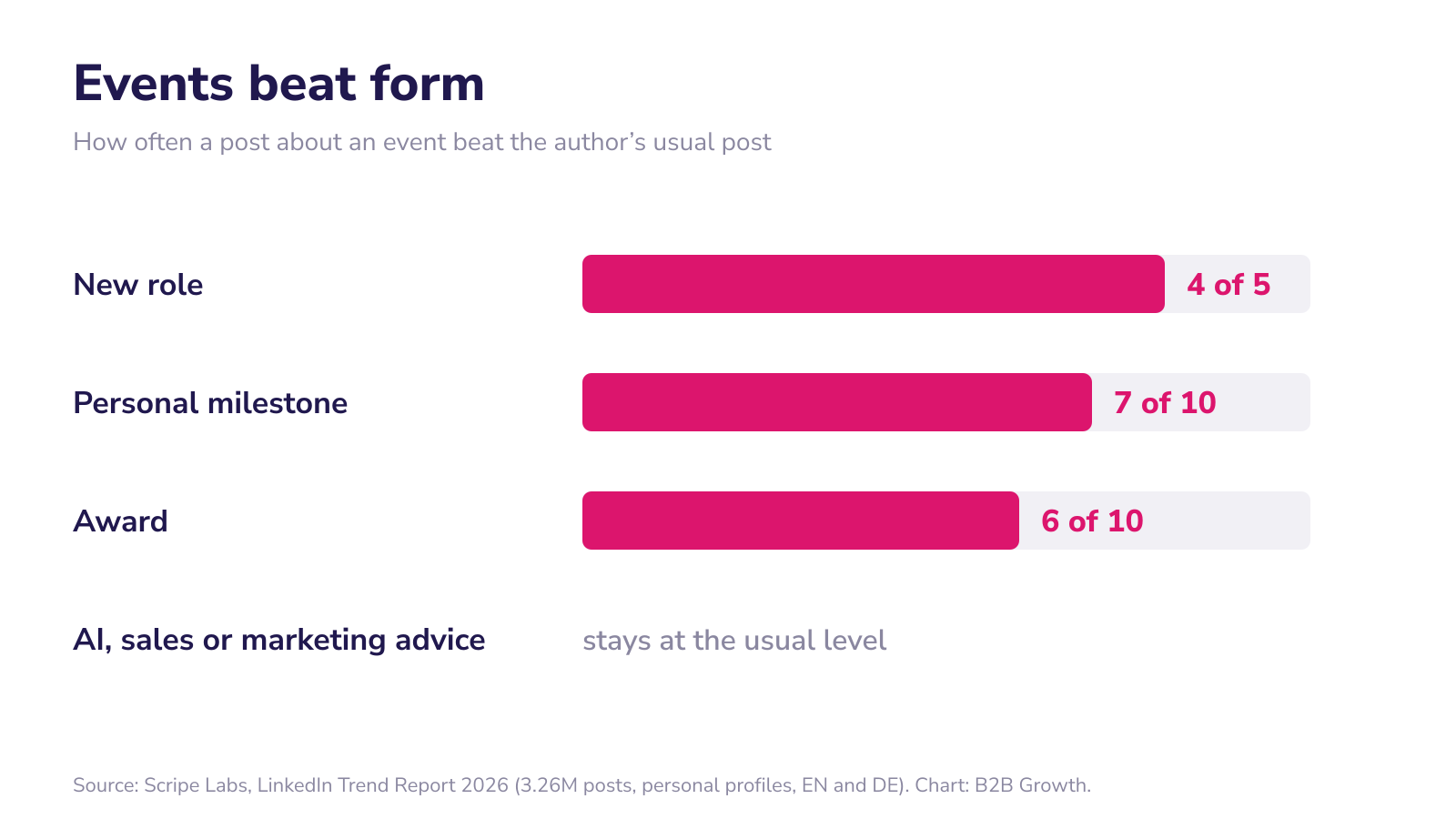
Posts about real events beat the author's usual post most of the time. An announcement of a new role did better four times out of five. A personal milestone did better seven times out of ten. An award, six times out of ten. Advice posts about AI, sales or marketing stayed at the author's normal level.
By post type, personal milestones earned 1.49×, career before-and-after posts 1.23×, vulnerable moments 1.17× and company wins 1.15×. The weakest types were event and webinar invitations (0.76×), offer highlights (0.85×) and trend analysis (0.85×).
The report also says that form, meaning length, opening and format, adds roughly 1.2–1.4×. The event adds more.
What this means in practice. The best content does not come from a writing trick. It comes from the leader's life: a decision, a new hire, a visit to a client, a trade fair, a mistake, a milestone for the team. That is why, when we run a leader's profile, the first question in our weekly 30-minute call is not "what should we write?" but "what happened this week, and what is coming up?" If we know a leader is going to a fair, we ask for a photo. Then there is a real story to tell.
A simple tool that follows from this: a quarterly events calendar. List the things that will happen in the next three months, such as launches, anniversaries, new people, decisions and events, and plan posts around them.
Finding 2: longer posts and stories still win, but the gap is shrinking
Posts of 300 words or more earned 1.15× in 2026, down from 1.24× in 2025. Posts under 80 words earned 0.76×. Long posts were also saved 1.5 times and sent on 1.7 times more often per view.
Note the trend: the advantage of length fell by about a third in one year. When everyone starts doing the same thing, the advantage gets smaller. Length alone is not a strategy.
The shape of the post matters more. Story-shaped posts earned 1.23× and personal stories 1.18×. The educational tone, the most common one (37% of English posts, up from 33%), is one of the weakest. A long lesson, 300+ words in a teaching tone, earned only 0.79×. The best combination was news in the first line followed by a story: 1.59×.
This matches what we see. Very short posts with nothing in them rarely work. Neither do posts where a leader lectures. What works is a story with a point: what happened, in order, with people in it, and the lesson at the end, not at the start.
Finding 3: start with "I", not with a question
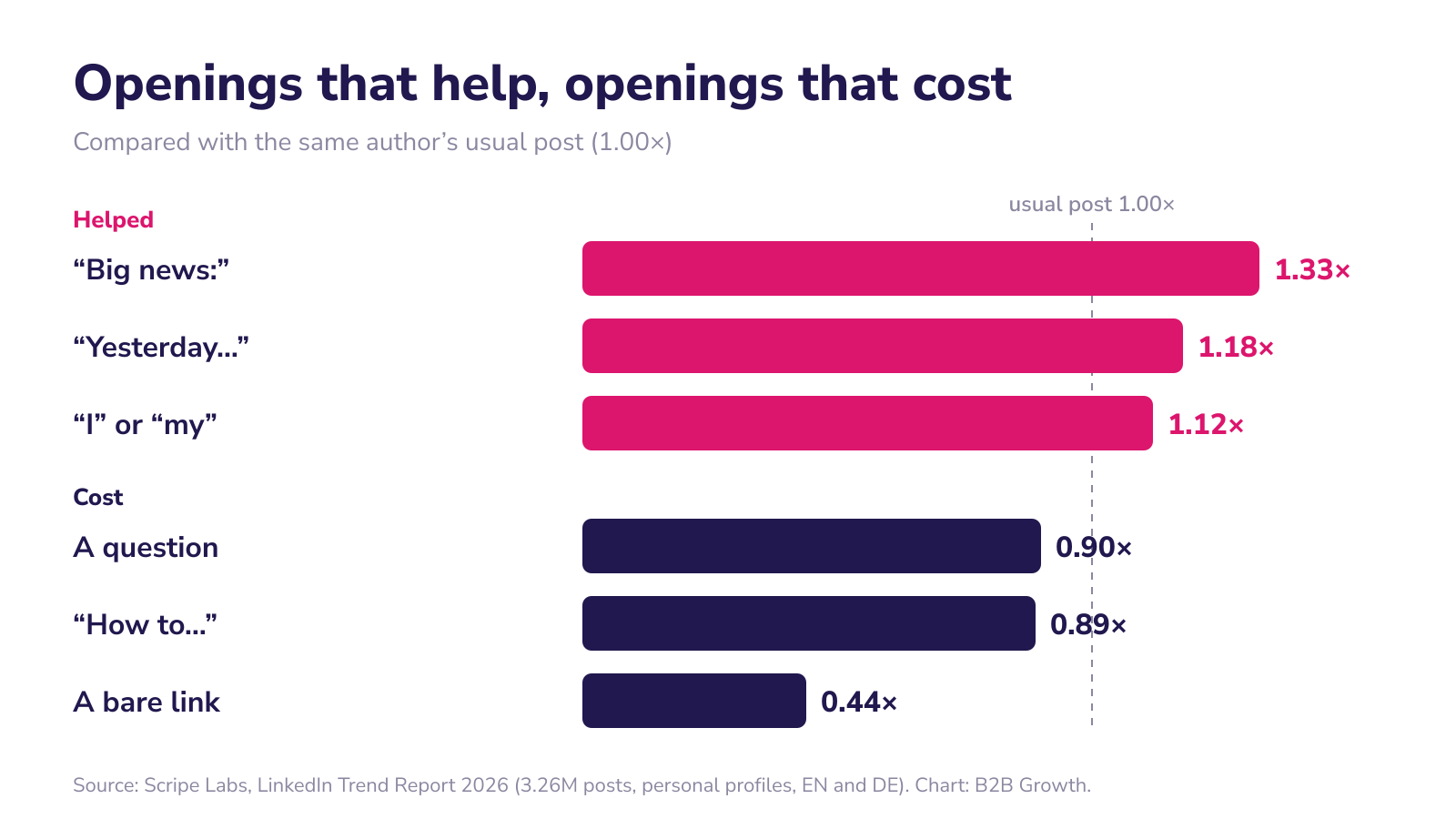
Openings that started with "I" or "my" earned 1.12× and 1.25× more profile visits per view. Opening with a question earned 0.90×, opening with "you" 0.92×. The question opening cost engagement in every industry, account size and language.
Some specific openings did well: "Big news:" (1.33×), "Excited to share..." (1.31×), "Yesterday..." (1.18×), "X years ago..." (1.17×), "I failed..." (1.16×). Others did badly: a bare link (0.44×), "Great to see..." about someone else's news (0.68×), an invitation like "Join us..." (0.76×), "Huge thanks to..." (0.85×), "X mistakes..." (0.89×) and "How to..." (0.89×).
And at the end of the post: ending with a question does not bring more comments. Asking people to share earned 1.13×, a P.S. 1.11×. Yet 75% of authors never use a P.S.
Finding 4: a real photo beats a designed graphic
A post with a single image earned 1.60× the engagement of the same author's text post. A set of photos earned 2.26×, a document carousel 1.53×, a video 1.45×.
But the type of image matters. A real photo earned 1.14×, a person in the picture 1.10×, an award in hand 1.22×. A designed text graphic earned 0.87×, any text on the image 0.90×, an infographic 0.90×. Very polished images earned 0.96×, raw ones 1.08×. Eye contact with the camera: 1.10×.
In manufacturing, a text-only post earned just 0.49×. If your company makes physical things, show them.
What this means in practice. For a leader's profile, a phone photo of the team, the factory floor or the client meeting will usually do better than a designed slide. This is one more reason to ask leaders for photos when they are out and about.
Finding 5: the time of day hardly matters, but consistency does
The hour of posting changed results by up to 5%. People spend a lot of energy on the perfect time. It is not where the result comes from. Our experience is the same: one post goes far, the next does not, and you cannot tell why from a single post. Look at ten. For company pages, we explain how to compare posts fairly in our article on engagement rate per 1,000 followers.
Frequency is more interesting. For small accounts (500–1,999 followers), a month with 10–19 posts brought 2.2 times more new followers. Above 50,000 followers it made no difference. Doubling the number of posts cost about 11% of views per post, but the monthly total grew.
There is also good news for people who take a break. After two to four quiet weeks, the next post earned 1.07×; after a month, 1.13×.
Our adaptation for leaders. The data says more posts help small accounts grow. We agree with the direction. But a leader who has never posted will not start with ten posts a month. If they try, they will stop. So we start with a rhythm they can keep, usually once a week, and build from there. And if they miss a few weeks, that is not the end. Start again.
Finding 6: LinkedIn did not get harder for most people
You have probably read that organic reach on LinkedIn has collapsed. The best-known source is Richard van der Blom, who tracks the LinkedIn algorithm. His 2025 reports described a sharp fall in both reach and engagement on personal profiles.
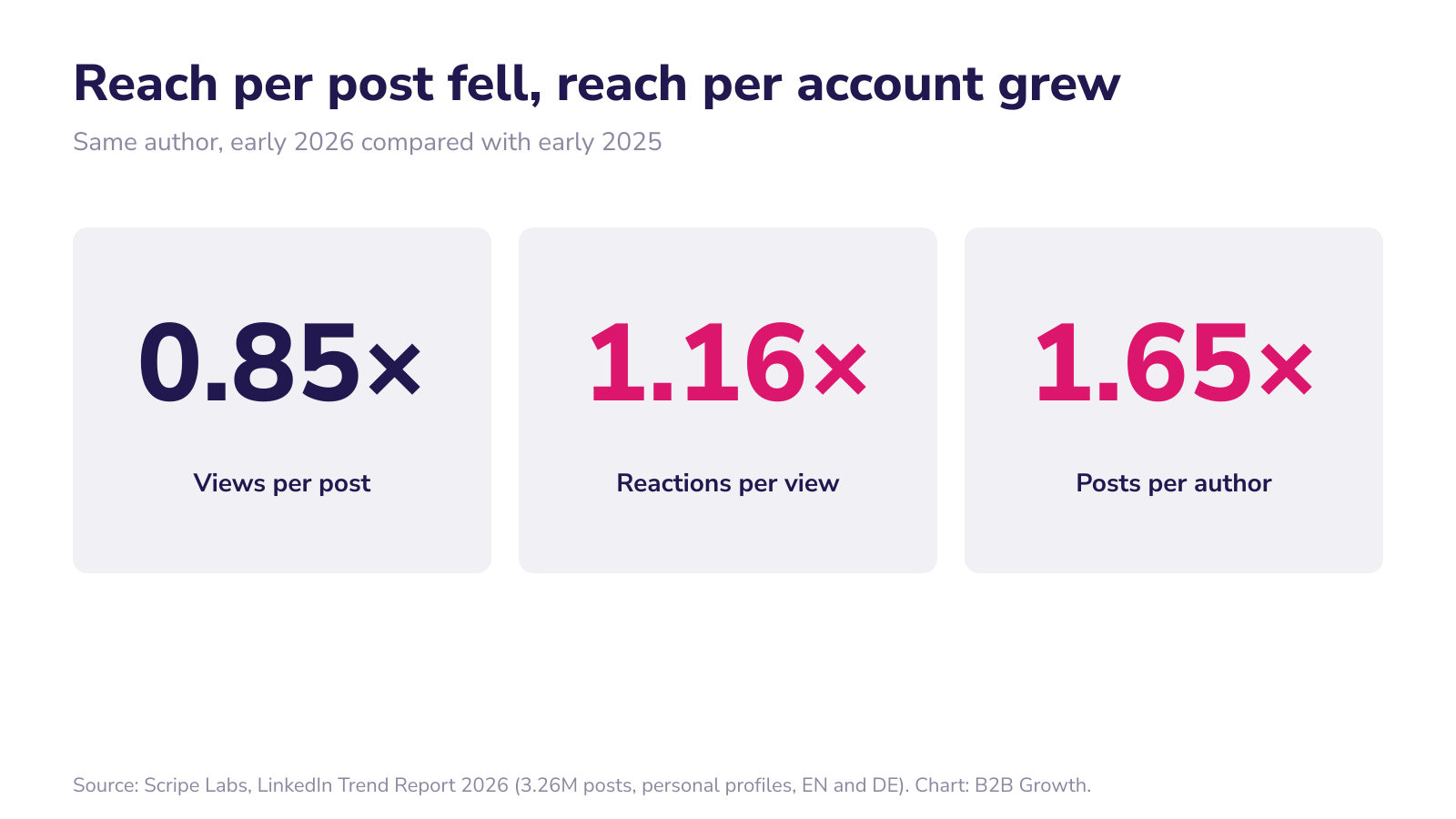
Scripe looked at it differently, by comparing each author with themselves. The same author earned 1.06× in early 2026 compared with early 2025. Accounts over 50,000 followers earned 0.90×, and 58% of them were declining. Views per post fell to 0.85×, but reactions per view rose to 1.16×, and people posted 1.65 times more. Reach per post fell; reach per account grew.
A typical post reaches 8–10% of followers on accounts with more than 10,000 followers, and 20–30% on accounts with fewer than 2,000.
So who is right? Both, in a way. They measure different things. What both suggest is that fewer people see an average post, and the people who do see it react more, if it deserves it.
Finding 7: half of the old advice does not hold
The report tested 22 popular pieces of LinkedIn advice. Eleven were not supported by the data: keep posts short, open with a question, end with a question, post in the morning, teach and educate, write about AI, use designed graphics, write one-line paragraphs, "big accounts have it easy", "personal stories don't belong on LinkedIn" and "comment bait is dead". Seven depended on the author: hashtags, emojis, links, posting every day, carousels, video and calls to action. Only one held for everyone: show your face.
We like this list because it is a good antidote to LinkedIn myths. Try it with your own team: let people guess first, then show the result. It makes people question the "rules" they have picked up.
What the data does not say
The report is about content. It says very little about the things that, in our experience, decide whether a leader's LinkedIn works over time:
- A clear target group. Who are you writing for, and what do they want to know?
- A plan. About ten topics from a strategy, so the leader does not start from a blank page every week.
- Social capital. If you only talk about your own things and never take part in other people's conversations, people will not take part in yours. That is why we recommend commenting: one thoughtful comment a day if you are at zero, and around 20 minutes a day once it is a habit.
- The leader's own voice. Posts that are 100% AI-generated, with nothing real inside, do not work. People can tell. Ironically, a report by an AI writing company confirms it: what works is real events, real photos and personal stories, the things only the leader has.
A word about company pages
The report does not cover company pages, and the rules there are not the same. For example, in the Socialinsider 2026 benchmarks for company pages, document carousels had the highest average engagement rate: 7.00%, against 5.20% for all posts. For personal profiles, Scripe finds real photos ahead of carousels. We compare the two page types in our article on company page vs personal profile. The rule we follow is simple: always say which type of page you are talking about, and do not copy personal-profile advice onto a company page without checking.
A checklist for your next ten posts
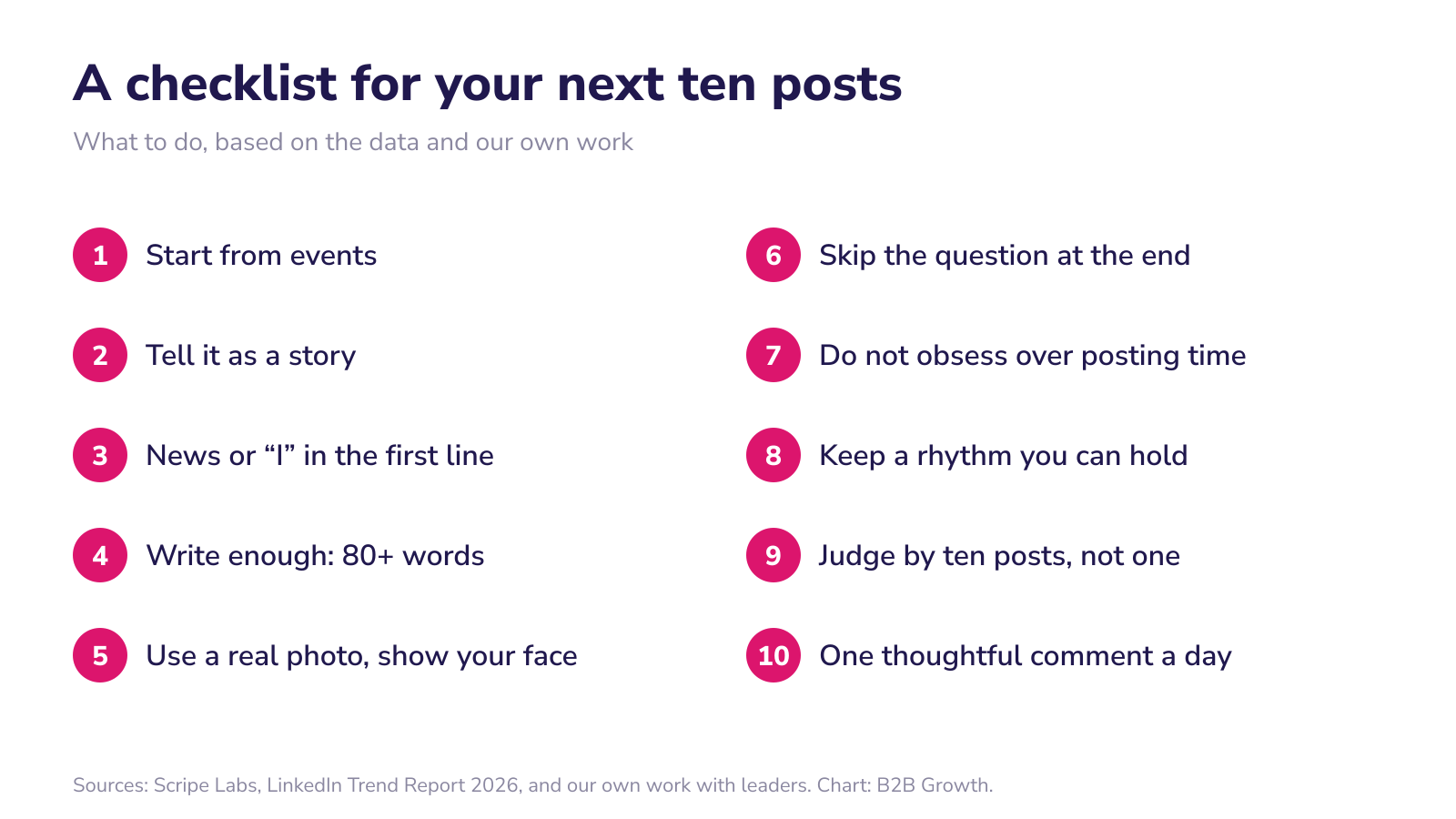
- Start from events. What happened, or what is about to happen?
- Tell it as a story. In order, with people, the lesson at the end.
- Put the news or "I" in the first line. Not a question.
- Write enough. Most good posts need more than 80 words.
- Use a real photo rather than a designed graphic. Show your face.
- Skip the question at the end. Try a P.S. or ask people to share instead.
- Do not obsess over the posting time.
- Keep a rhythm you can hold. Once a week is a fine start.
- Judge by ten posts, not one. Compare each post with your own average.
- Comment on other people's posts. One thoughtful comment a day.
Frequently asked questions
What is the biggest LinkedIn trend in 2026? According to Scripe Labs' 2026 report, posts about real events, such as a new role, a milestone or an award, beat an author's usual post most of the time, while generic advice stays average.
How long should a LinkedIn post be in 2026? Posts of 300+ words earned 1.15× and posts under 80 words 0.76× compared with the author's usual post. The advantage of length is shrinking, so the story matters more than the word count.
Does the time of posting matter on LinkedIn? Very little. In the report, the hour of posting changed results by up to 5%.
Should I start a LinkedIn post with a question? The data says no. Question openings earned 0.90× and ending with a question did not bring more comments.
Did LinkedIn reach really collapse? It depends on how you measure. Views per post fell, but reactions per view rose, and for most authors results were about the same as a year earlier.
Does this apply to company pages? Not directly. The report covers personal profiles only.
Want to know where your company page or your leaders' profiles stand today? We run a free LinkedIn audit for B2B companies across Europe. You choose what we look at: a leader's personal profile or your company page. We'll tell you what works and what holds you back. Book a free audit
Want us to look at your LinkedIn?
The LinkedIn audit is free, for your company page or a leader's profile, and you speak directly to Indrek.
Get a free audit