
LinkedIn budget approval: the one-page business case
By Indrek Põldvee, founder of B2B Growth
Indrek has taught people how to use LinkedIn for more than six years. In 2019 he founded B2B Growth, which has trained more than 4,000 people on LinkedIn, worked on more than 1,000 profiles and built 50+ LinkedIn strategies. Before that he co-founded Sorry as a Service, which went through Techstars London in 2017, and hosted the Estonian entrepreneurship podcast “Hakkame tegutsema” (100+ interviews, 350,000+ downloads). He has delivered trainings across the Baltics, Finland, Sweden, the Netherlands, the UK, Hungary and India. Indrek on LinkedIn
About 11 min read
How do you get a LinkedIn budget approved? Put it on one page. Say who you need to reach, why LinkedIn, what it costs in money and in the leader's time, what you will measure in month one, month three and month six, and what the risks are. Use one argument the CFO already understands: most of your buyers are not buying right now. Research for the LinkedIn B2B Institute puts it at about 95% in any given quarter. LinkedIn is how they remember you when they are ready.
Key takeaways
- Most buyers are not in the market today. According to Ehrenberg-Bass research for the LinkedIn B2B Institute, companies change providers of services like banking, legal advice or software about every five years. So only about 20% are in the market in a year, and about 5% in a quarter.
- One page beats a deck. A decision-maker should understand the ask in two minutes: the goal, the cost, the measures, the risks and a review date.
- Say the risks yourself. LinkedIn does not bring sales in the first month. If you say it before anyone asks, the plan becomes more believable, not less.
Contents
- Why LinkedIn budgets get rejected
- The 95-5 rule: the argument your CFO needs
- The one-page business case, section by section
- What to put in the cost line
- What to measure, and when
- The risks, said out loud
- The meeting itself
- Common mistakes
- How to apply this
- FAQ
Why LinkedIn budgets get rejected
A marketing manager wants to start LinkedIn properly. The CEO says yes in the corridor. Then the plan goes to the management board, and it stops.
In our experience, it is rarely because the board dislikes LinkedIn. It stops for simpler reasons.
The plan is about posts, not about business. “Three posts a week, a content calendar, a new banner.” None of this tells a CFO why the company will be better off.
The plan promises sales too early. Someone writes “leads in the first quarter” to make the case stronger. The first quarter ends, the leads are not there, and the budget is cut. The next proposal has no chance.
Nobody counts the leader's time. The plan needs the CEO to post. But the CEO's hour is the most expensive hour in the company, and nobody wrote it down. When the CEO realises it later, they quietly stop.
There is no review date. A budget with no end and no check point looks like a cost that will never go away. Boards do not like that.
It is ten pages long. A long deck feels like hard work. It also hides the one thing the decision-maker wants to know: what exactly are you asking for?
A one-page business case fixes all five.
The 95-5 rule: the argument your CFO needs
Most budget conversations about LinkedIn go wrong at the same point. Someone asks: “How many sales did it bring last month?”
It is a fair question. But for most B2B companies it is the wrong measure. Here is why.
In 2021 Professor John Dawes of the Ehrenberg-Bass Institute published research for the LinkedIn B2B Institute. The LinkedIn B2B Institute calls it the 95-5 rule. The idea is simple. Companies change their providers of services like banking, legal advice, software or telecoms about every five years. So in a given year only about 20% of them are in the market. In a given quarter, about 5%. The other 95% are not buying at all.
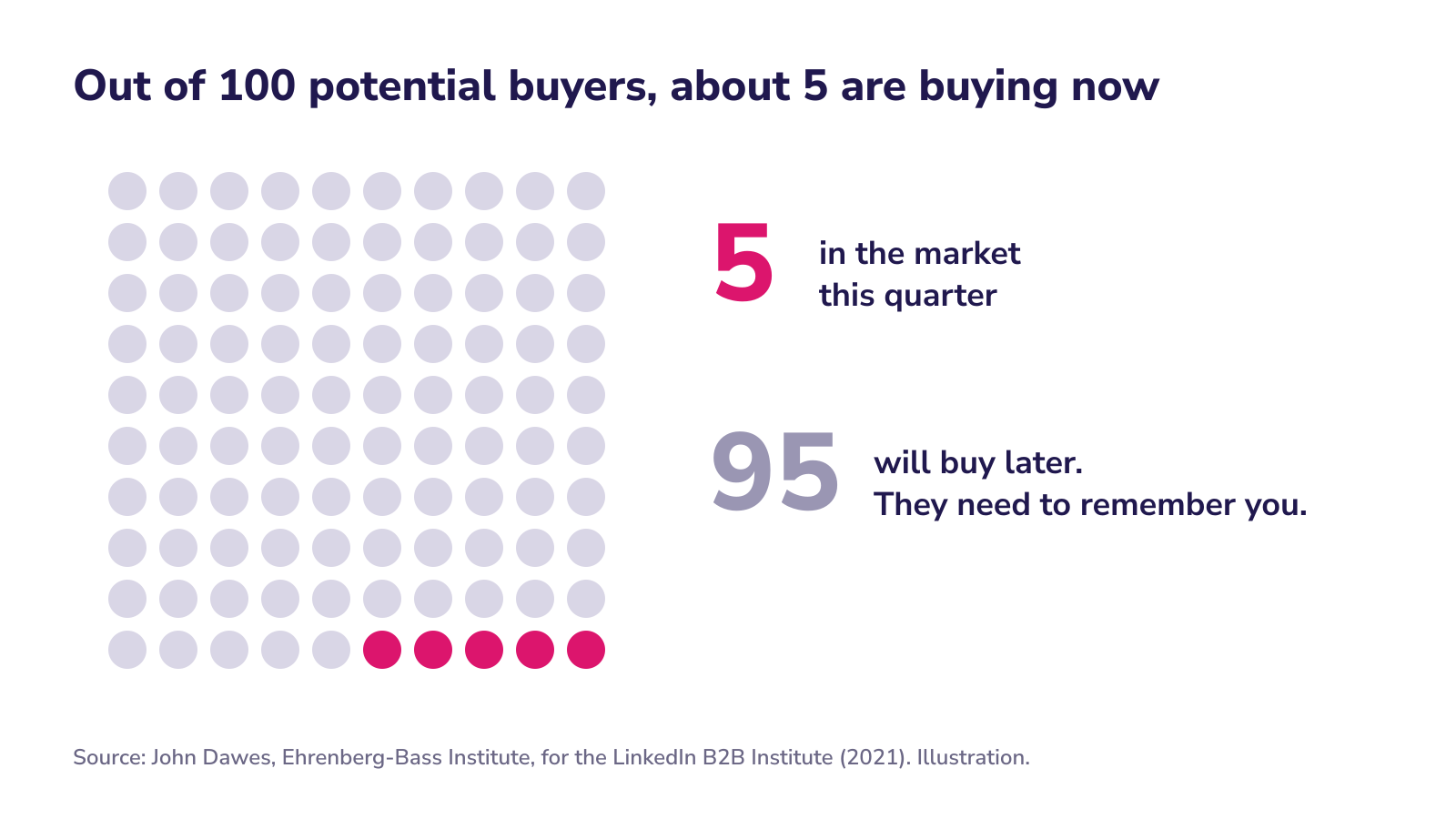
Think about what that means for your own company. If you sell to 400 companies in the Baltics, maybe 20 of them are looking for a new provider this quarter. The other 380 are not. You cannot sell to them today. But one day they will look. And when they do, they will start with the names they already know.
Dawes said it plainly in Marketing Week: “There aren't that many business clients that will say 'You know what, I'm comfortable signing a contract with a company that I've hardly ever heard of before.'”
This is the sentence to put in front of your CFO. LinkedIn is not mainly a channel for catching the 5%. It is how the 95% remember you before they are ready.
Two things to be honest about:
- The numbers are an average across categories. Your cycle may be shorter or longer. Use your own sales data if you have it: how long do your clients stay with a provider?
- The research is about advertising and brand memory. It is not a study of organic posts from personal profiles. The logic is the same: people buy from names they remember. But do not present it as proof that posts sell.
Why leaders' profiles, not only the company page
The 95-5 logic says you need to be remembered. On LinkedIn, people remember people better than logos. Posts from a leader's personal profile usually reach more people than posts from the company page, and they read like a person, not like an ad. We explain the difference in LinkedIn company page vs personal profile.
So in most business cases we see, the main line is not “more company page posts”. It is “two or three leaders who post regularly, plus a company page that supports them”.
The one-page business case, section by section
Here is the template. Seven short blocks. Each one should fit in two or three sentences.
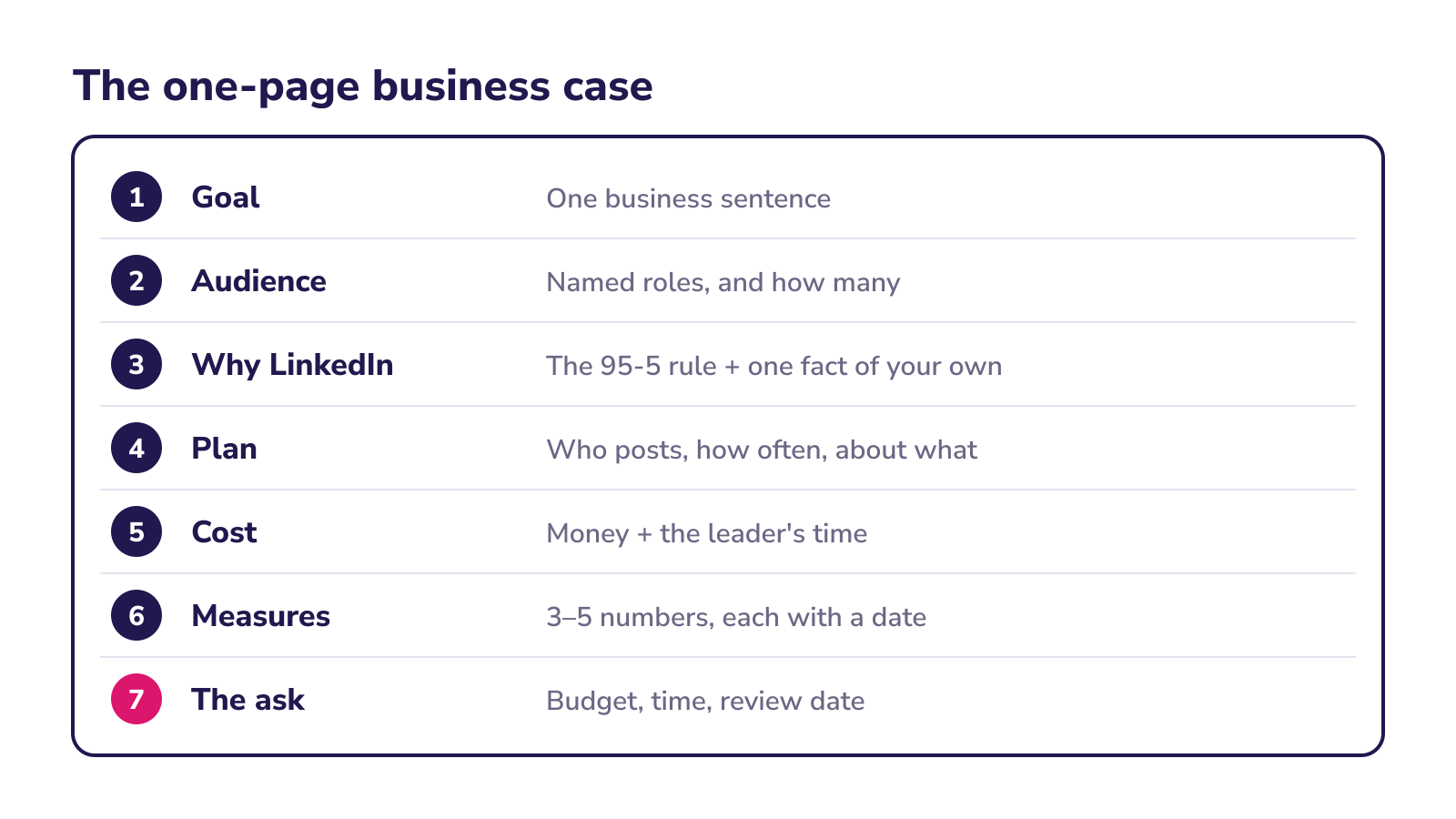
1. The goal. One sentence, in business words. Not “grow our LinkedIn”. Something like: “Be one of the three names our target clients think of when they start looking for a provider.”
2. Who we need to reach. Name the people, not the industry. “Logistics managers and CFOs in mid-sized manufacturing companies in Estonia and Latvia.” If you can, write how many there are. We describe how to define them in how to map your ideal LinkedIn audience.
3. Why LinkedIn. The 95-5 rule in two sentences. Add one fact from your own company, for example how your last big clients first heard of you. Only write what is true.
4. The plan. Who posts, how often and about what. For example: “The CEO and the sales director, one post a week each, on three topics. A weekly 30-minute call to plan the next two or three weeks.” Keep it concrete. If you want ideas on what a leader should post, start with real occasions.
5. The cost. Money and time, both. More on this below.
6. What we measure. Three to five numbers, with a date for each. More on this below.
7. The ask. One sentence. “We ask for a six-month budget of X and about two hours a week of the CEO's time, with a review on [date].”
That is the whole page. If the board wants more, bring an appendix. But the decision should be possible from the page alone.
Why one page works
A one-page business case is not about being short for its own sake. It forces you to decide.
When you have to write the goal in one sentence, you find out whether you have one. When you have to write the cost in one line, you find out whether you have counted the leader's time. When you have to write a review date, you find out whether you believe in the plan.
It also helps the person you are asking. A CEO or CFO can read one page between meetings. They can forward it. They can ask one clear question. A forty-slide deck usually gets “let's discuss this next month”.
What to put in the cost line
This is where most LinkedIn proposals are weakest. They show the agency fee or the tool licence. They do not show the real cost.
A full cost line has three parts.
Money. The agency fee, a freelancer, or the share of an internal person's salary. Plus any tools. If you are comparing an agency with doing it in-house, put both options side by side. If you choose an agency, read the contract terms before you sign.
The leader's time. This is the line people skip. A leader who posts needs time for:
- a short planning call, about 30 minutes a week;
- reading and approving drafts;
- replying to comments personally;
- commenting on other people's posts. If the leader is at zero, one thoughtful comment a day is a good start. Later, about 20 minutes a day.
Write it down: “About one and a half to two hours a week of the CEO's time.” It looks like a lot on paper. But a board that sees it written down will not be surprised later. And a CEO who agreed to it on paper is more likely to keep doing it.
The time of the people around the leader. Someone has to take the photo at the trade fair. Someone has to check facts with the product team. It is small, but it is real.
What we do in our own work
In our executive profile work, the core is a 30-minute call with each leader every week. We do it with every long-term client, because it creates accountability and keeps the rhythm. In the call we plan the topics for the next two or three weeks. When needed, we add a longer interview of up to 45 minutes, for example for a content audit. That is rare.
We mention this for one reason: whoever runs the programme, someone has to own the weekly rhythm. Put that person's time in the cost line.
Should the cost line show a number for return?
Be careful here. It is tempting to write “one new client pays for the whole year”. It may be true. But it is a promise you cannot check in month three, and the CFO will remember it.
A better way: show what one new client is worth to you, and let the board make the connection. “Our average client stays about X years and brings about Y per year.” That is a fact from your own books. It is not a promise about LinkedIn.
What to measure, and when
Sales come last. If you only measure sales, the first months will look like failure even when everything is going well. So split your measures by time.
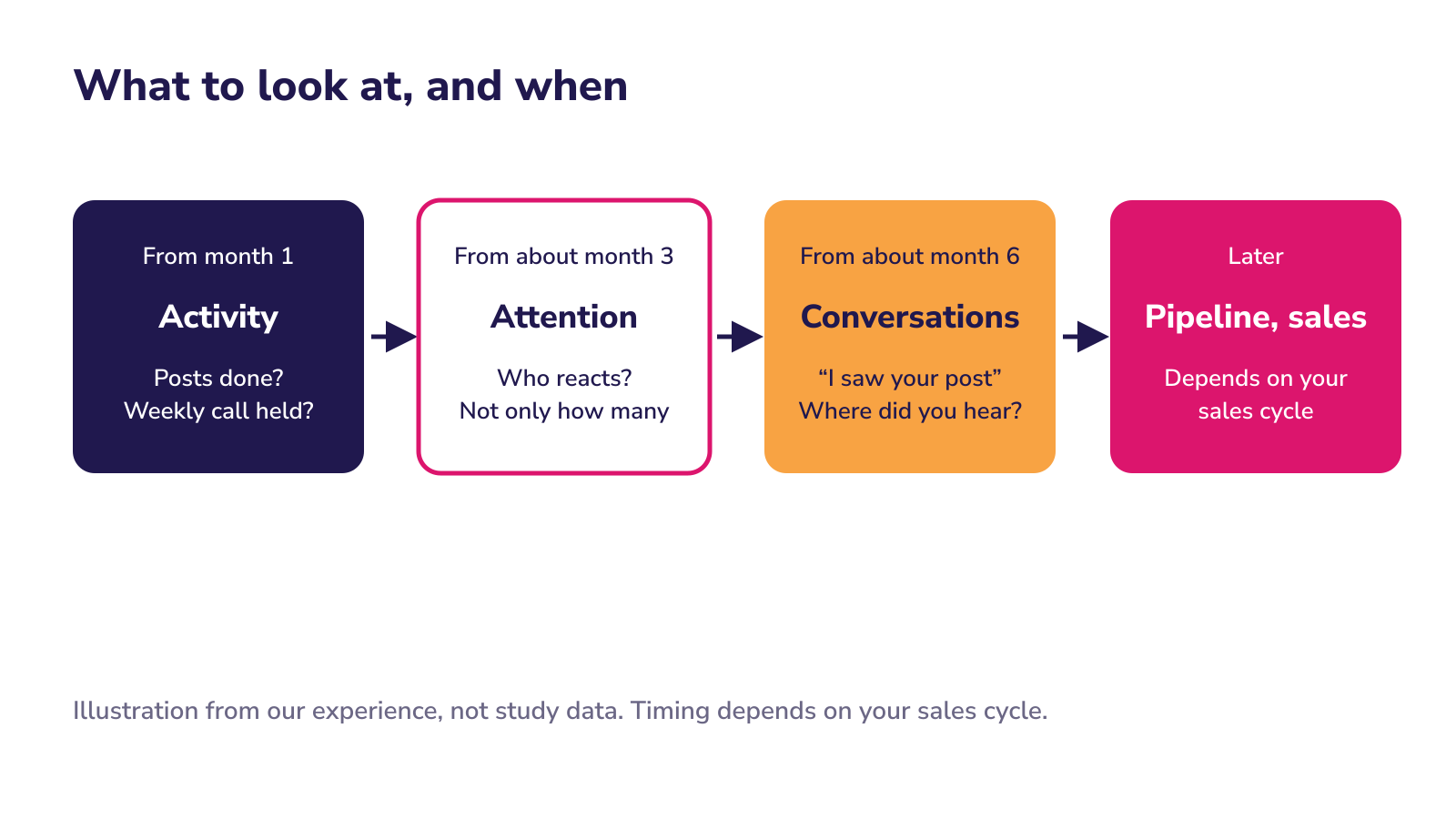
From month one: activity. Did the leaders post what was planned? Did the weekly call happen? Did they reply to comments? This is the only thing you fully control. If it is not happening, nothing else will.
From about month three: attention. Are the right people reacting and commenting? Not just how many, but who. Are people from your target companies starting to follow the leaders? To compare fairly, use engagement rate per 1,000 followers, and compare each leader with their own usual result, not with someone else's.
From about month six: conversations. Are people writing to the leaders? Does sales hear “I saw your CEO's post” in meetings? Ask every new contact one simple question: “Where did you hear about us?” Write the answers down.
Later: pipeline and sales. How long this takes depends on your sales cycle. If your clients change providers every few years, the effect builds slowly. That is exactly what the 95-5 rule predicts.
Write a date next to each measure in your business case. Then the board knows when to expect what, and nobody asks for sales in month two.
The timeline above is an illustration from our experience, not data from a study. Your timing will depend on your market, how often your leaders post and how long your sales cycle is.
The risks, said out loud
A business case without risks looks naive. A business case that names its own risks looks like someone has thought about it. Here are the ones we see most often, and what to write next to each.
The leader stops posting. In our experience, this is the biggest risk. A busy month, a trip, a crisis. Answer: a weekly call that someone else owns, and content prepared two or three weeks ahead.
The posts sound like the company website. Then nobody reads them. Answer: posts built from conversations with the leader, in the leader's own voice.
Results take longer than the board expected. Answer: the measures by date, agreed in advance.
The person who runs it leaves. Answer: write the strategy, the topics and the target group down, so someone else can continue.
It does not work for us. Possible. Answer: a review date. “After six months we look at activity and attention. If they are not there, we stop or change the plan.”
A review point is your friend. It turns an open-ended cost into a test with a clear decision point. Boards approve tests much more easily than open-ended costs.
The meeting itself
You have the page. Now the meeting.
Send the page before the meeting. People decide better when they have read it once alone.
Start with the goal, not with LinkedIn. “We want to be on the shortlist when our target clients look for a provider.” LinkedIn comes second, as the way to get there.
Bring one real example. A leader in your industry who posts well. Or a post from your own CEO that started a client conversation. One example is stronger than ten statistics.
Answer the sales question honestly. When someone asks “how many sales will it bring?”, say: “In the first months, none that we can count. Here is what we will see first, and here is when we look again.” Then point at the measures.
Ask for a clear decision. Not “what do you think?” but “can we start on [date] with a review on [date]?”
Common mistakes
- Promising leads in the first quarter. It sounds strong. It kills the next budget.
- Forgetting the leader's time. Then the leader stops, and the budget looks wasted.
- Measuring only followers. Followers are easy to count. Who reacts matters more than how many.
- Comparing yourself with the biggest accounts. Compare each leader with their own usual result.
- No review date. Without one, the plan looks like a cost that never ends.
- Ten pages instead of one. The decision gets postponed.
- Using statistics you cannot source. If a CFO asks “where is this from?” and you do not know, the whole page loses trust.
How to apply this
- Write the goal in one business sentence.
- Name the people you need to reach, and count them if you can.
- Add the 95-5 argument with the source, plus one true fact from your own company.
- Describe the plan: who posts, how often, about what, and who owns the weekly rhythm.
- Write the full cost: money, the leader's time and the time of the people around them.
- List three to five measures with a date for each: activity first, attention next, conversations later.
- Name the risks yourself and write the answer next to each.
- Set a review date, usually after about six months.
- Send the page before the meeting and ask for a clear decision.
If you are not sure where your leaders' profiles or your company page stand today, start there. A LinkedIn audit gives you the starting point that every measure in the business case needs.
Frequently asked questions
How do I justify a LinkedIn budget to a CFO? Use one page. Show the goal in business words, the full cost including the leader's time, measures with dates, the risks and a review date. The main argument is the 95-5 rule: most buyers are not in the market today, so you need them to remember you when they are.
What is the 95-5 rule in B2B? Research by Professor John Dawes of the Ehrenberg-Bass Institute for the LinkedIn B2B Institute. Companies change many service providers about every five years. So about 20% are in the market in a year and about 5% in a quarter. The other 95% will buy later.
How long does it take for LinkedIn to bring results? Activity can be measured from week one. In our experience, attention from the right people shows from around month three, and conversations later. Sales depend on your sales cycle. That is why it makes sense to agree on a review after about six months.
Should the business case include ROI? Show what one client is worth to you, from your own numbers. Do not promise how many clients LinkedIn will bring. The board can make the connection itself.
How much time does a CEO need for LinkedIn? Plan for about one and a half to two hours a week: a 30-minute planning call, approving posts, replying to comments and some time commenting on other people's posts. Write it in the cost line.
Company page or leaders' profiles? Both, with different jobs. In most business cases the main line is two or three leaders who post regularly, with a company page that supports them.
Want to know where your company page or your leaders' profiles stand today? We run a free LinkedIn audit for B2B companies across Europe. You choose what we look at: a leader's personal profile or your company page. We'll tell you what works and what holds you back. Book a free audit
Want us to look at your LinkedIn?
The LinkedIn audit is free, for your company page or a leader's profile, and you speak directly to Indrek.
Get a free audit