
How to choose a LinkedIn agency: 10 questions to ask before you sign
By Indrek Põldvee, founder of B2B Growth
Indrek has taught people how to use LinkedIn for more than six years. In 2019 he founded B2B Growth, which has trained more than 4,000 people on LinkedIn, worked on more than 1,000 profiles and built 50+ LinkedIn strategies. Before that he co-founded Sorry as a Service, which went through Techstars London in 2017, and hosted the Estonian entrepreneurship podcast "Hakkame tegutsema" (100+ interviews, 350,000+ downloads). He has delivered trainings across the Baltics, Finland, Sweden, the Netherlands, the UK, Hungary and India. Indrek on LinkedIn
About 11 min read
Short answer: Choose a LinkedIn agency by how well it prepares, not by how well it presents. Before you sign, ask what they already know about your business, who will write, how much of your time they need, what they will measure and not promise, what the first 90 days look like with dates, what is in the price, and who owns the work if you leave.
Key takeaways - Buyers rarely choose on brand. In Infoteam's 2014 buyer study, 79% agreed to a first meeting because the seller referred to a real need, and 17% because of the brand. - The best signal is preparation. A good agency arrives with questions about your business, not with a ready-made package. - Read the contract for four things: who owns the content and accounts, what happens when you are slow, what happens when they are slow, and how you leave.
Contents
- Why LinkedIn agencies all look the same
- What good buyers check
- 10 questions to ask a LinkedIn agency before you sign
- Red flags
- What a good proposal contains
- Contract terms that protect you
- How we work
- How to apply this
- FAQ
Why LinkedIn agencies all look the same
Open five LinkedIn agency websites. You will probably read the same words on all of them. Thought leadership. Personal branding. Strategy. Content. Engagement. Results. A row of client logos. A few happy quotes.
That is not anyone's fault. The work is hard to show on a website. A good LinkedIn post is easy to recognise when you see it, but almost impossible to describe in advance. So every agency describes the same thing in the same words.
For you as a buyer, this is a problem. You cannot choose by reading. You can only choose by talking.
And this is where many buyers make one small mistake. They let the agency run the first call like a presentation. They hear about the agency, its process and its clients. Then they ask for a price. Then they compare prices.
Price is a fair thing to compare. But it is the last thing, not the first. Two offers at the same price can mean very different things. One agency writes from an interview with your leader, another from a short written brief. One reports on who engaged, another only on how many. One lets you leave with a month's notice, another makes leaving hard.
You will only see these differences if you ask. That is what this article is for.
What good buyers check
There is very little research on how companies choose LinkedIn agencies. There is more on how B2B buyers choose suppliers in general. One of the more detailed studies was done by Infoteam, a Swiss sales consultancy. In 2014 it asked 300 B2B buyers and 198 sellers what makes the difference when buyers choose a supplier. Infoteam's Phil Kreindler later built on this work in the book Customerized Selling (2016).
Two things to keep in mind. The data is from 2014. And it is about large B2B deals, not about LinkedIn agencies. So read it as a direction, not as a law. But the direction is very clear, and it matches what we hear in our own calls.
Brand matters less than you think
When buyers were asked what got them to agree to a first meeting, 79% said it was a reference to a real need they had. Only 17% said it was the supplier's brand.
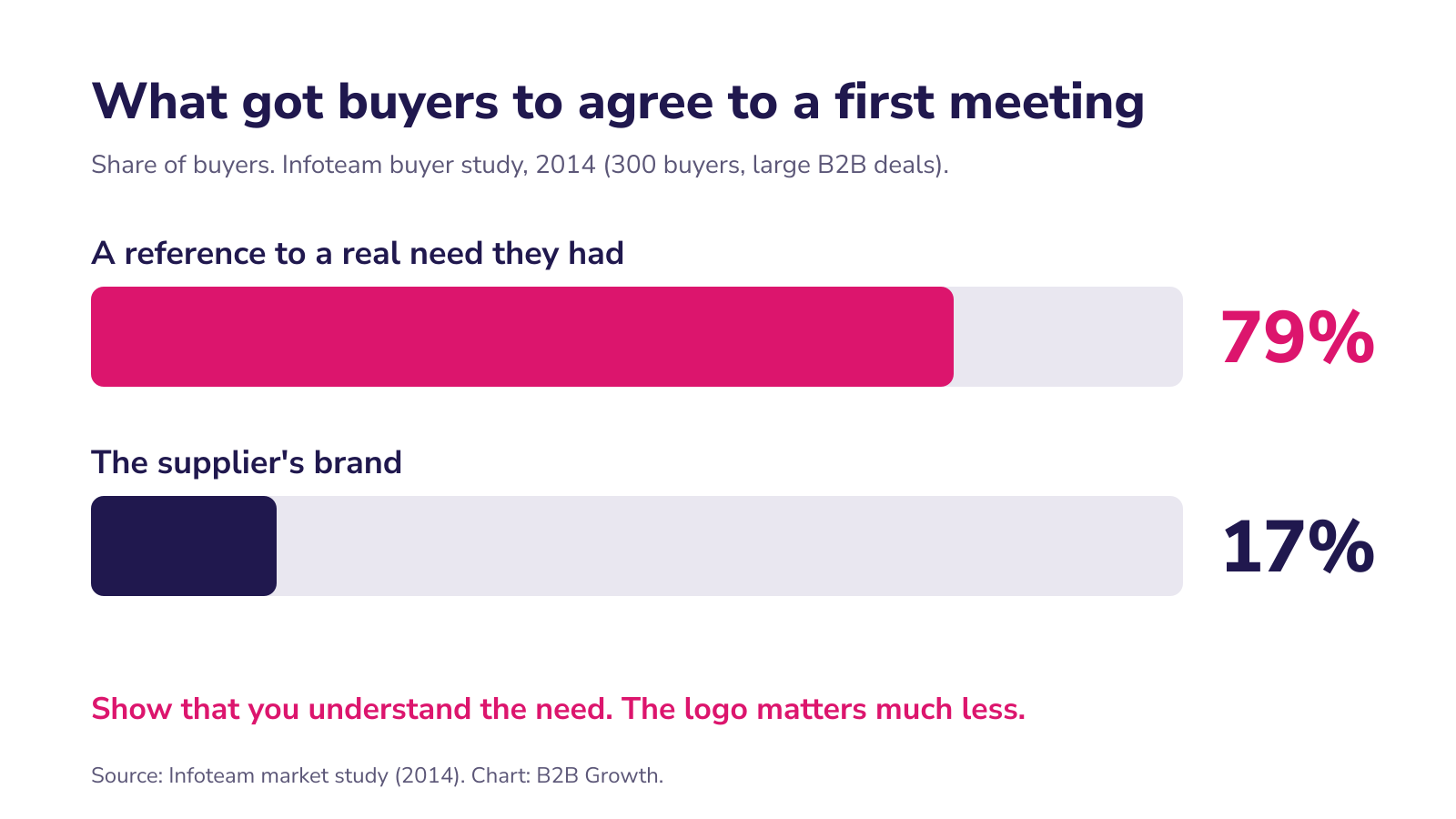
For you, this works the other way round too. If an agency's strongest argument is its wall of logos, it is leading with the thing that mattered least to buyers. The better question is: did they understand your need before they started selling?
Buyers want two things, and often do not get them
The same study asked buyers what was very important to them, and where sellers needed to improve. Two answers stand out:
- The seller understands our business at the first meeting. Very important for 71% of buyers. 63% said sellers need to improve here.
- A summary of the meeting and the next steps. Very important for 56%. 48% said this needs to improve.
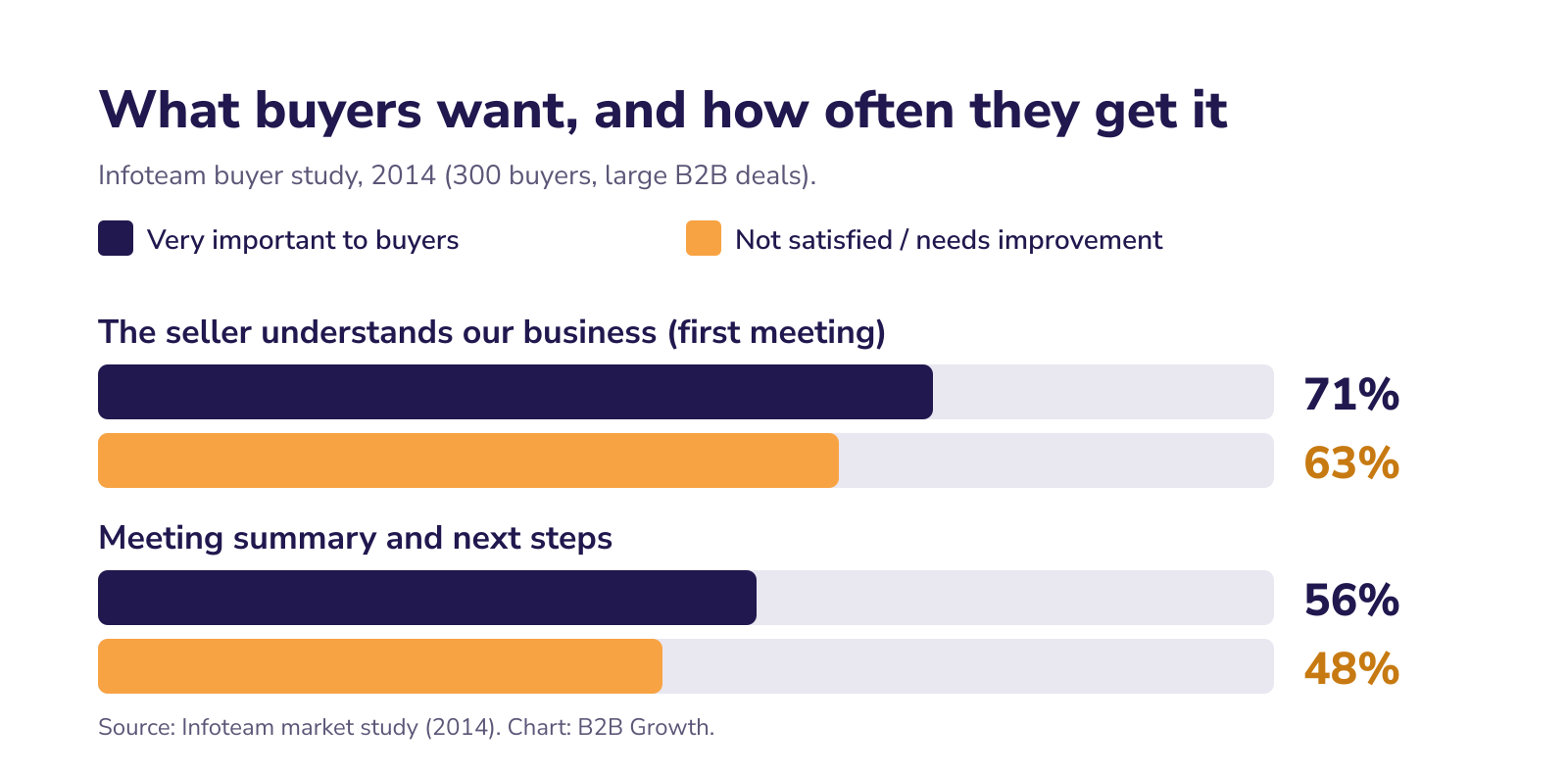
The gap between "very important" and "not satisfied" is the useful part. It tells you what to look for. What matters most is that the agency understands your business before the first call. How each agency shows this is up to them.
The study also found that for 67% of buyers, a clear solution and a clear price in the proposal were very important. That sounds obvious. It is still worth checking.
The person who decides is often not on the call
One more point. The person on the call is often not the only one who decides. A marketing manager talks to the agency, and then has to explain the choice to the CEO or the board. If you are that marketing manager, think early about how you will explain the choice to your leadership.
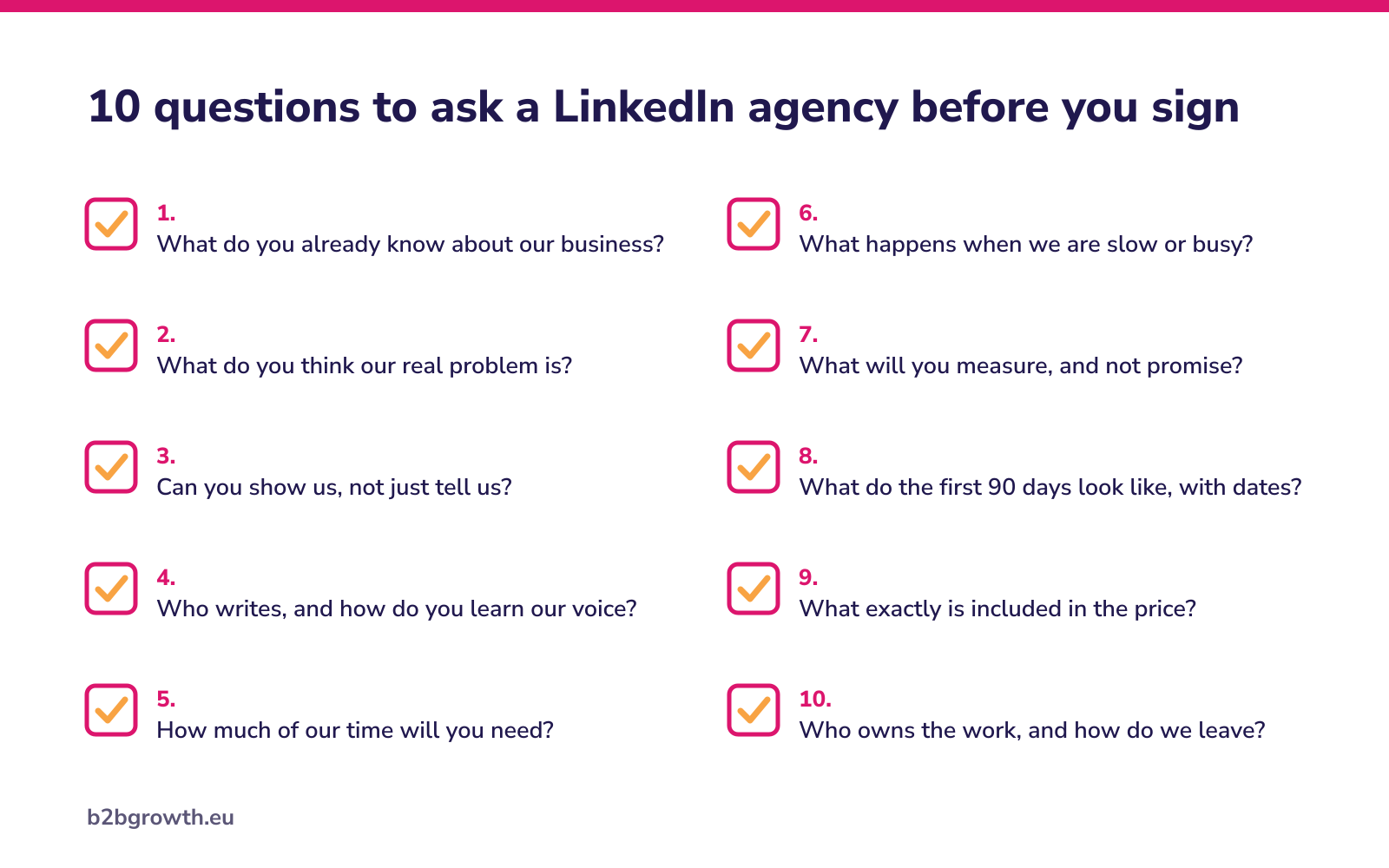
10 questions to ask a LinkedIn agency before you sign
These are the questions we would ask if we were the buyer. None of them is a trick. A good agency will be glad you asked.
1. What do you already know about our business?
This is the best first question, because it tests preparation. Before a first call, an agency can look at your website, your company page, your leaders' profiles and your posts from the last few months. That takes less than an hour.
A good answer sounds like this: "You post mostly product news. Your CEO has a strong profile but rarely posts. Your recruiting posts get more reactions than anything else. Is that right?" A weak answer is a general talk about LinkedIn.
2. What do you think our real problem is?
You want to hear a hypothesis, not a diagnosis. Something like: "We think your leaders' expertise is not visible yet. Is that the main gap, or is it something else?" The question mark matters. It shows they are listening, not only selling.
Be careful with an agency that knows the answer before it has heard your goals. Be equally careful with one that has no view at all.
3. Can you show us, not just tell us?
Proof beats a promise. Ask to see real work: a post written for a leader like yours, a monthly report with the client's confidential data removed, a case study with a period and a comparison. Ask whether you can talk to an existing client.
Some agencies will offer to write a sample post from your first conversation. That is a good sign. It shows they can find a story in what you said.
4. Who writes, and how do you learn our voice?
This question tells you more about quality than any portfolio. Does the writer talk to your leader, or work from a written brief? Is there an interview? How often? What happens when the leader says "this does not sound like me"?
In our experience the best posts come from interviews. A leader talks. A writer turns it into posts in the leader's own words. The leader does not rewrite the text, but comments on what to change: which words they never use, what they like, what they do not. Over time the writer learns the voice. Ask the agency how it does this.
Whether to post from the leader's profile or the company page is covered in our article on company page vs personal profile.
If the answer is "AI writes the posts", ask what a person adds. Empty posts generated entirely by AI do not work. People can tell.
5. How much of our time will you need?
Every honest agency needs some of your time. Your leaders know things no writer can invent. If an agency says it needs nothing from you, the posts will sound like it.
Ask for a number. For example: one interview a month per leader, and a few minutes to approve each post. Ask who on your side should be the contact person, and how much of their week it will take. Then check whether your people can really give that time.
6. What happens when we are slow or busy?
Most buyers forget this question. In month three it is the one that matters most. Leaders travel. Interviews get cancelled. Approvals wait in someone's inbox for a week.
A good agency has a plan for this, and ideally it is written into the contract. For example: a fixed number of working days for feedback; company page posts that go out after a set period without comments; writing from existing material (talks, articles, events) when an interview is missed. Without a plan like this, the rhythm stops. One month there are four posts, the next month none, and LinkedIn becomes "that channel we tried once".
7. What will you measure, and what will you not promise?
Ask both halves.
What they will measure: engagement compared with your own starting point, who engages (job titles, industries, companies), and which kinds of posts work best for you. Ask to see a sample report. A good report tells you what to do next, not only what happened. What engagement numbers really tell you is covered in our article on engagement per 1,000 followers.
What they will not promise: a good agency is clear about what content can and cannot do. Content builds visibility and trust. It can lead to conversations. It does not guarantee a number of leads, meetings or followers. If someone guarantees a number of leads from content alone, ask how. LinkedIn's reach changes from year to year, and nobody controls it.
8. What do the first 90 days look like, with dates?
A good answer is a simple timeline with two lines: what you do, and what they do. Training, workshop, strategy, profile updates, content plan, first posts. Each step with a date and a name.
Ask when the first posts will go out. A fair answer depends partly on you: how quickly interviews happen and materials arrive. Be careful with a fixed promise that does not depend on anything you do.
In our work, training comes before the first post, and that changes the whole first quarter.
9. What exactly is included in the price?
The research says a clear solution and a clear price matter to most buyers. Make sure you understand:
- How many posts per month, and for which accounts.
- Whether strategy, profile work, training and reporting are included or extra.
- Whether there are hourly charges on top of a monthly fee.
- What happens to the price if you add a leader or another company page.
You should be able to say in one sentence what you pay each month and what you get for it. If you cannot, ask again.
10. Who owns the work, and how do we leave?
Ask this before you sign, while everyone is friendly. Who owns the posts, the images, the strategy and the content plan? Who has admin access to the company page? Can you take all your material with you if you stop? What is the notice period? Is there a minimum term, and what happens after it?
There is nothing negative about this question. A confident agency answers it calmly. It knows clients stay because the work is good, not because leaving is hard.
Red flags
None of these automatically means "do not sign". But each one deserves a follow-up question.
- The proposal could be for any company. Your name is on the cover, but the goals, the plan and the examples are generic.
- A price before a single question about you. Packages are fine. A package sold before anyone understood your goals is not.
- Guaranteed numbers of leads, meetings or followers. Content does not work that way, and reach is outside anyone's control.
- Nobody can say who will write. You do not need names on day one, but you should know the roles and how the writer will learn your voice.
- Automated connection or message campaigns from your leader's account. This puts the account and your leader's reputation at risk. Thought leadership content and automated outreach are two different things.
- Reports that only count likes and followers. Ask who engaged, not only how many.
- You cannot get admin access or your material back. Your company page and your leaders' profiles are yours.
- No plan for busy months. Every client has them. The agency should have an answer ready.
What a good proposal contains
A good proposal does not have to be long. It has to be clear enough that someone who was not on the call can understand it. We would look for six things:
- Your goals, in your words. If the first page is about the agency and not about you, something is wrong.
- The plan. Which accounts, how often, what kinds of content, what happens in the first three months.
- What it gives each person. The CEO, marketing, HR and sales each want something different. A good proposal names it for each of them.
- A clear price. One monthly number, what is included, the minimum term.
- What could slow things down, and how it will be handled. An honest list of risks builds more trust than a perfect picture.
- Next steps with dates. Not "let us know", but "call on Tuesday, decision by the 20th, training in the first week".
Contract terms that protect you
We are not lawyers, and this is not legal advice. But these are the points we would read twice in any LinkedIn agency contract:
- Ownership. The content, images, strategy and plans made for you should be yours to keep and use.
- Access. Admin rights to your company page stay with your company. The agency gets the access it needs, not more. A leader's personal profile is never "handed over".
- Approval. Personal posts should always wait for the leader's approval. For company page posts, a clear rule (for example, they go out after a set number of days without comments) keeps the rhythm going.
- Your side of the deal. How much time is expected from you, and what happens if you cannot give it.
- Their side of the deal. What happens if the agency delivers fewer posts than agreed. A fair contract says the missing posts are made up.
- Term and notice. The minimum term, the notice period, and what the handover looks like.
- Confidentiality. What the agency may say publicly about working with you, and what stays private.
If all of this is clear before you sign, most problems never happen.
How we work
A short note on our own process, so you can compare. After the first call we send a proposal. In our experience it is three separate documents: the proposal, an overview of how we work, and a free audit of your current LinkedIn. In the audit we map what has already been done and what works well. We agree a shared timeline with dates up to the first posts. These typically go out four to six weeks after the start, depending on how quickly interviews and materials arrive. We have a 30-minute call with each leader every week. A longer interview, up to 45 minutes, happens only when it is really needed. If we deliver fewer posts than agreed, we make them up the next month at no extra cost. The content belongs to you. We recommend starting with at least six months, but we do not do long contracts: one month is enough notice to stop. We do not promise leads from content.
Since 2019 we have worked on more than 1,000 personal and company profiles and built 50+ LinkedIn strategies in 15+ industries and 12+ countries. You can see one example in our BENU case study. What is included for leaders is on our executive profiles service page.
How to apply this
- Before the first call, write down your goal in one sentence, and who else will decide.
- In the first call, start with question 1. Let the agency show what it already knows.
- Ask for proof: a sample post, a sample report, or a call with a current client.
- Go through questions 5 to 10 before you talk about price.
- Read the proposal as your CEO would. Could you decide from it without having been on the call?
- Read the contract for ownership, access, both sides' obligations and notice.
- Compare price last, and compare what is included, not just the number.
Before you think about content, decide who you want to reach on LinkedIn at all. Our article on the ideal LinkedIn audience covers this.
FAQ
How do I choose a LinkedIn agency? Judge it by its preparation and its questions, not by its presentation. Ask what it already knows about your business, who will write, how much of your time it needs, what it will measure, what is in the price and how you can leave.
What questions should I ask a LinkedIn agency? Start with these: What do you already know about us? What do you think our real problem is? Can you show us real work? Who writes, and how do you learn our voice? How much of our time do you need? What happens when we are slow? The full list of ten is above.
Should a LinkedIn agency guarantee leads? No. Content builds visibility and trust and can lead to conversations, but nobody controls LinkedIn's reach or a buyer's timing. Be careful with guaranteed numbers of leads, meetings or followers.
Who should own the content an agency creates? You should. The posts, images, strategy and plans made for your company and your leaders should stay with you, and admin rights to your company page should stay with your company.
How much time does working with a LinkedIn agency take? It depends on the scope. Expect some time from every leader who posts, for example one interview a month and a few minutes to approve each post, plus a contact person who coordinates.
Is a well-known agency brand a good reason to choose it? On its own, no. In Infoteam's 2014 buyer study, only 17% of buyers agreed to a first meeting because of the supplier's brand. 79% did because of a reference to a real need.
Want to know where your company page or your leaders' profiles stand today? We run a free LinkedIn audit for B2B companies across Europe. You choose what we look at: a leader's personal profile or your company page. We'll tell you what works and what holds you back. Book a free audit
Want us to look at your LinkedIn?
The LinkedIn audit is free, for your company page or a leader's profile, and you speak directly to Indrek.
Get a free audit