
What to post on LinkedIn as a CEO: the occasion calendar
By Indrek Põldvee, founder of B2B Growth
Indrek has taught people how to use LinkedIn for more than six years. In 2019 he founded B2B Growth, which has trained more than 4,000 people on LinkedIn, worked on more than 1,000 profiles and built 50+ LinkedIn strategies. Before that he co-founded Sorry as a Service, which went through Techstars London in 2017, and hosted the Estonian entrepreneurship podcast "Hakkame tegutsema" (100+ interviews, 350,000+ downloads). He has delivered trainings across the Baltics, Finland, Sweden, the Netherlands, the UK, Hungary and India. Indrek on LinkedIn
About 12 min read
What should a CEO post on LinkedIn? Start with what happens. A new role, a new person on the team, a milestone, an award, a launch, a client visit, a trade fair. In a 2026 study of 3.26 million posts, posts about real occasions beat the author's usual post most of the time. Advice posts did not. Plan your occasions with a simple quarterly calendar.
Key takeaways
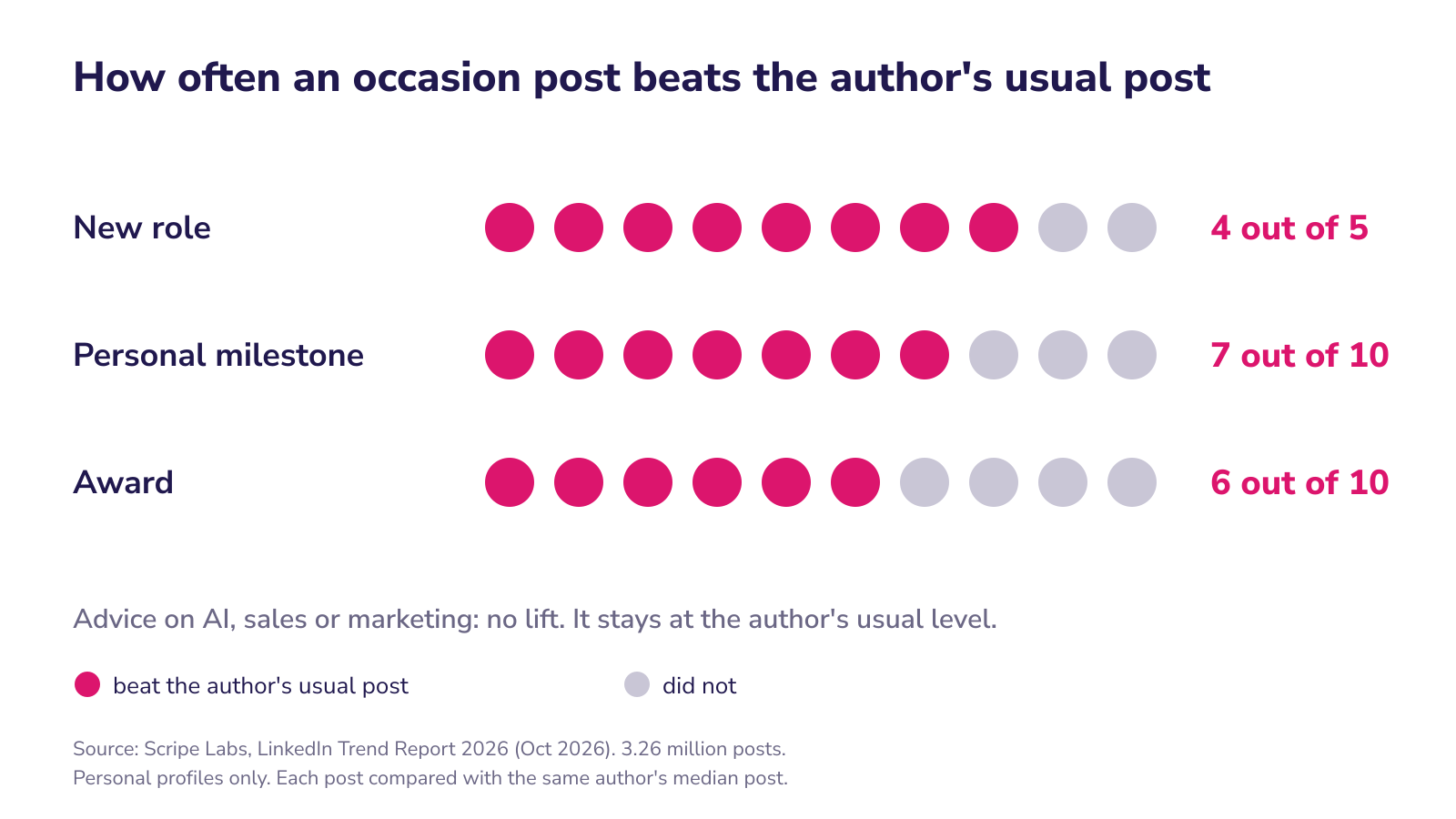
- Occasions beat advice. On personal profiles, a new-role post beat the author's usual post 4 times out of 5, a personal milestone 7 out of 10, an award 6 out of 10. Advice on AI, sales or marketing stayed at the usual level. That is what a 2026 study by Scripe Labs found.
- You already have the occasions. You just do not plan them. Leaders go to events, visit clients and stand at trade fairs every month. Most of it never reaches LinkedIn. A quarterly calendar fixes that.
- Find them in a weekly 30-minute call. Two questions: what happened, and what is coming? Ask for a photo in the moment. Write the story afterwards, news first and lesson last.
Contents
- Why occasions win
- You already have the occasions
- The 12 occasions every executive has
- Building the calendar
- How we find occasions: the weekly 30-minute call
- Turning an occasion into a story
- Photos of the moment
- When there is no occasion
- How to apply this
- FAQ
Why occasions win
Most leaders looking for LinkedIn content ideas for executives think LinkedIn wants their expertise. So they write lessons. Five things I learned about leadership. Three trends in our industry. What every CFO should know about AI.
The data says something different.
Scripe Labs published its LinkedIn Trend Report 2026 in October. It looked at 3.26 million public posts from about 385,000 authors, in English and German, from January 2024 to September 2026. The method is the useful part. Every post is compared with the same author's usual post, the median of their last 20 posts. So a big account does not win just because it is big.
Here is what it found about occasions:
- A post announcing a new role beat the author's usual post 4 times out of 5.
- A personal milestone beat it 7 times out of 10.
- An award beat it 6 times out of 10.
- Advice posts about AI, sales or marketing stayed at the author's normal level.
The report also ranks post types. Personal milestones earned 1.49× the author's usual result. Career before-and-after posts earned 1.23×, vulnerable moments 1.17× and company wins 1.15×. At the bottom: event and webinar invitations at 0.76×, offer highlights at 0.85× and trend analysis at 0.85×.
And one more number that explains the title of this article. According to the report, form, meaning length, opening and format, adds roughly 1.2–1.4×. The occasion adds more.
Three things you should know about this data:
- It is about personal profiles only. Company pages are not in it. Everything here is about a leader's own profile. Why a leader's profile and a company page do different jobs, we explain in LinkedIn company page vs personal profile.
- It shows correlation, not cause. People post about a new role when something real happened. That is partly the point.
- Scripe sells an AI writing tool. Keep that in mind. There is also no Estonian in the data.
We cover the full report in a separate article. Here we only take one finding and turn it into a working tool.
Does this mean expertise is useless?
No. It means expertise travels better inside an occasion.
A lesson on its own asks the reader to sit through a lecture. A story about something that happened gives them a reason to read. The expertise is still there. It sits in the last third of the post, where you say what you learned. Scripe found that a long lesson, 300+ words in a teaching tone, earned 0.79×. News in the first line followed by a story earned 1.59×. Same knowledge. Different wrapping.
You already have the occasions
Here is the thing most leaders miss. They do not lack occasions. They have more than they could ever post.
Leaders go to events and seminars. They visit clients. They travel. They stand at trade fairs. They hire people, close projects, make decisions and sometimes get them wrong. Every one of these is a possible post.
The problem is that nobody writes them down. The fair happens. Everyone is busy. Two weeks later it feels too late to post about it. Then a quiet month comes and the leader stares at a blank page, wondering what to write.
We see the same pattern in many accounts: four posts one month, zero the next. LinkedIn becomes the channel people use when they have time. And they never have time.
When we audit a leader's profile, we look at their last posts and ask one question: which occasions were never posted? A new role announced only on the company website. An anniversary that passed without a word. A team milestone that only lives in an internal newsletter. These are the easiest posts a leader will ever write, and they are the ones that get skipped.
The 12 occasions every executive has
This is the list we use when we build a leader's calendar. It is not a list from a study. It is a working checklist of the kinds of things that happen to almost every leader in a year. Where the Scripe data says something about a type, we add it.
| # | Occasion | What the post is about |
|---|---|---|
| 1 | New role or new responsibility | What changes, why you said yes, what you want to do first. New role: 4 out of 5. |
| 2 | A new person on the team | Who they are and why you wanted them. The post is about them, not you. |
| 3 | A team milestone | A finished project, a first year, a number the team is proud of. Personal milestones: 1.49×. |
| 4 | An anniversary | "Ten years ago we started with..." Openings that count the years back earned 1.17×. |
| 5 | An award | The work and the people behind it. Award: 6 out of 10. |
| 6 | A launch | Why you built it and what problem it solves. Company wins: 1.15×. |
| 7 | A decision | What you changed, and why. Including the doubts. |
| 8 | A client visit | What you heard. What surprised you. No client names without permission. |
| 9 | A trade fair | What people asked about at the stand. What you saw on the floor. |
| 10 | An event or seminar you attended | The one idea you took home, and what you will do with it. |
| 11 | A talk or panel you gave | The question from the audience you are still thinking about. |
| 12 | A mistake or a hard moment | What went wrong and what you do differently now. Vulnerable moments: 1.17×. |
Two notes on this list.
Awards need care. The data likes awards. Our experience says award posts often fall flat. Both are true. A post that says "we won because our product is the best" makes nobody care. A post about the people who did the work, and what it took, is a story. People live along with a story. They do not live along with a trophy.
Launches are not ads. Scripe found that offer highlights earned 0.85×. A launch post that reads like a product sheet is an offer highlight. A launch post about why you built it, who pushed for it and what you got wrong on the way is a company win. One more detail from the report: AI as a topic earned 0.98×. But when AI was the company's own product, it earned 1.11–1.19×. Your own launch is an occasion. Your opinion on the latest AI model usually is not.
Building the calendar
An occasion calendar is a simple list of the things that will happen in the next three months, with a week next to each one. It takes about half an hour to make. Here is how.
1. Take one quarter. Thirteen weeks is long enough to plan, short enough to be realistic.
2. Write down the fixed dates. Trade fairs. Conferences where you speak or attend. Company anniversaries. Planned launches. Annual results. Board decisions that will become public. Ask your assistant or your marketing team. They usually know more dates than you do.
3. Add the likely occasions. New hires starting. Projects ending. Client visits you already have in the calendar. Trips. You do not need exact dates. "Sometime in month two" is enough.
4. Decide: before or after? For most occasions, the best post comes after. Scripe found that event and webinar invitations earned 0.76×, and openings like "Join us..." earned 0.76× as well. So do not make the invitation your main post. If you want people to come to your stand, mention it briefly. Save the real post for afterwards: what happened, who you met, what you heard.
5. Mark who takes the photo. Write it next to the occasion. If nobody is responsible, there will be no photo.
6. Fill the gaps with your plan topics. Occasions will not cover every week. That is fine. The other weeks come from your content plan: the ten or so topics that come from your target group and strategy. We explain how a LinkedIn content plan is built in a separate article.
7. Look at it every week. The calendar is not a document you write once. Things move. New occasions appear. The weekly call keeps it alive.
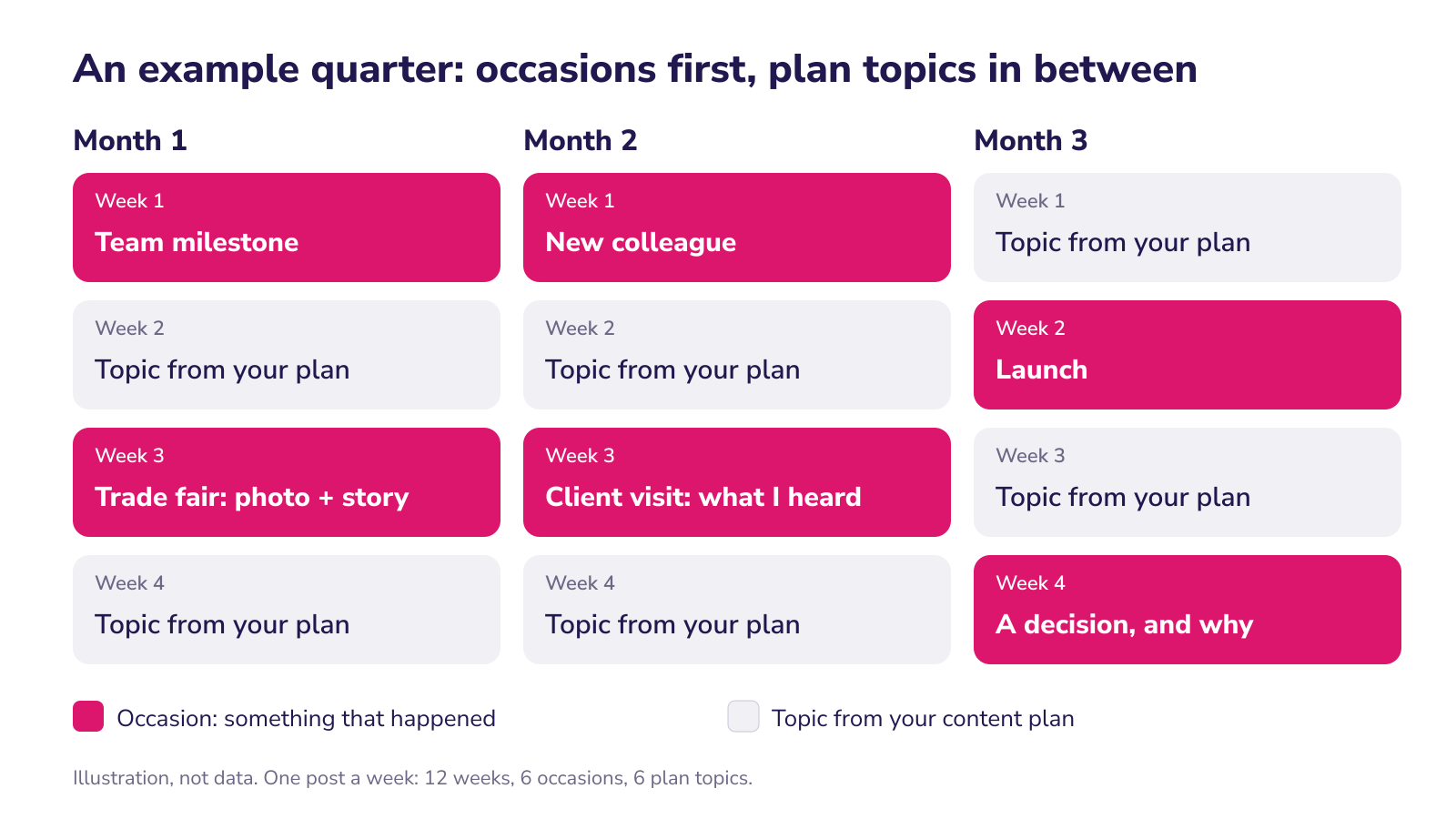
The example above is an illustration, not data. One post a week, twelve weeks, half occasions and half plan topics. For most leaders that is a good start. More occasions in a busy quarter, fewer in a quiet one.
How often? For a leader who has never posted, once a week is a rhythm they can keep. But a leader who starts with four posts a week usually stops by the end of the month. Start with what you can hold.
How we find occasions: the weekly 30-minute call
This is the part of our work that makes the calendar real.
When we work with a leader, we start with a strategy: the target group, what the leader wants to be known for, and about ten topics. We explain how to find the target group in how to map your ideal LinkedIn audience. After that, the backbone is a short call every week, about 30 minutes. In that call we plan the topics for the next two or three weeks.
The most useful questions are simple:
- What happened this week?
- What is coming in the next two or three weeks?
- Where are you going? Who are you meeting?
Leaders go to events, to clients, to trade fairs. When we know it in advance, we can ask: take a photo at the fair. Take a photo with the team. Then we write a story about it. It comes naturally, because it really happened.
This is also why we prefer interviews to written briefs. Talking is easier than writing. People say things in a conversation that they would never type. In our experience, one interview usually gives enough for three or four posts. We describe that process step by step in a separate article.
We use the same approach with the leaders of Port of Tallinn: one clear topic per leader, and posts built from conversations, not from briefs.
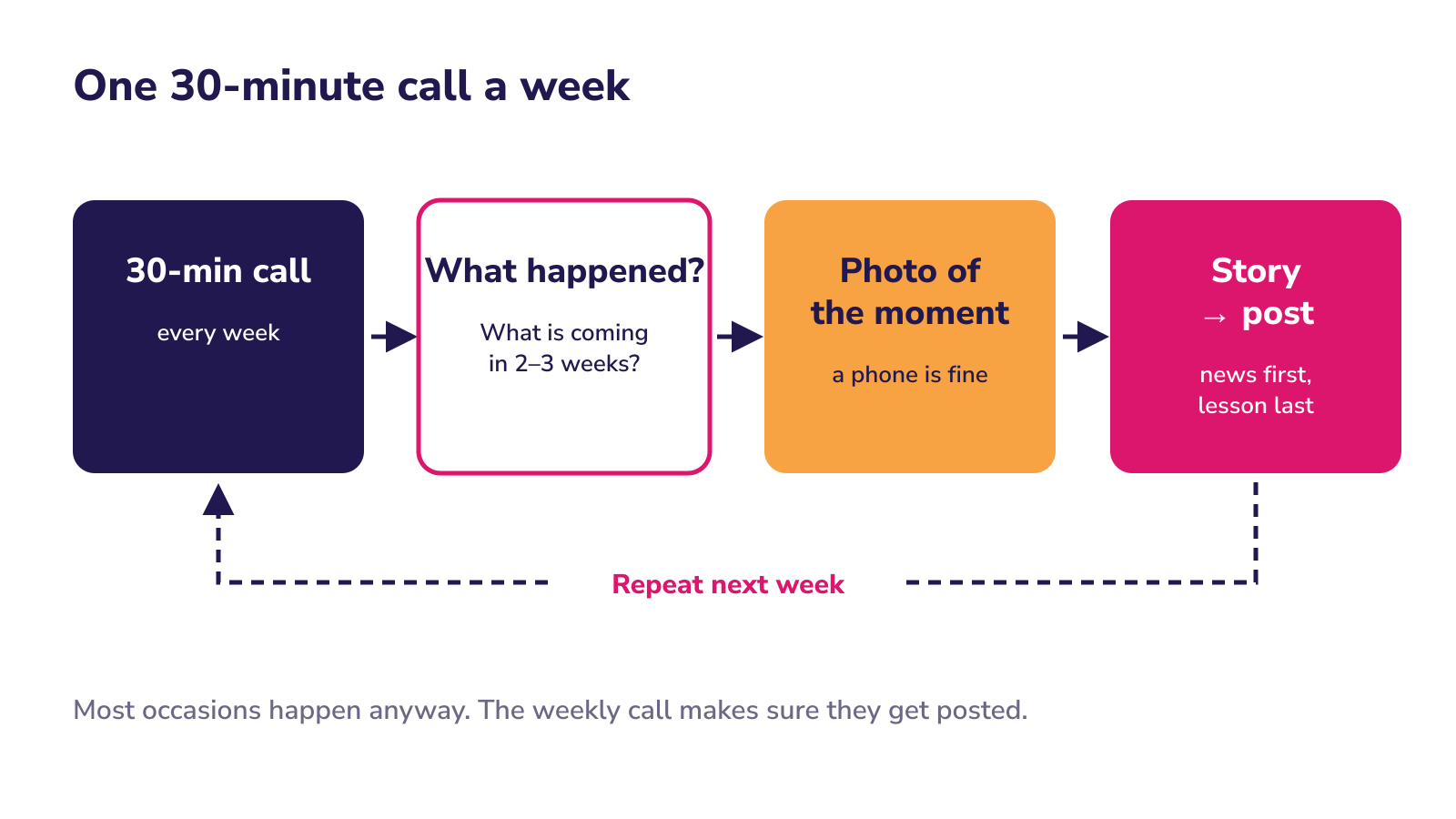
What this looks like in practice: in our executive profile work, we have a call with each leader every week. In it we plan the topics for the next two or three weeks. When the leader goes to an event, a client or a trade fair, we ask for a photo and write a story from it. We write the posts in the leader's voice and keep content ready two to three weeks ahead. The leader replies to comments personally.
The call does not have to be with an agency. A marketing manager, an assistant or a colleague can ask the same two questions every Monday. What matters is that someone asks, every week, and writes the answers down.
Turning an occasion into a story
An occasion gives you something to say. It does not write the post for you. A new-role announcement can still be a dull press release.
Here is the shape that works.
The first line is the news. Not a question. Not "Excited to be here." The news itself. Scripe found some openings worked clearly better than the author's usual post: "Big news:" 1.33×, "Excited to share..." 1.31×, "Yesterday..." 1.18×. Others cost: "Great to see..." about someone else's news 0.68×, "Huge thanks to..." 0.85×. Thank people inside the post, not in the first line.
Then the story, in order. What happened, with real people in it. A short scene is better than a summary. "At 9 a.m. the first visitor at our stand asked a question I could not answer" is better than "We had many good conversations."
The lesson goes last. This is where your expertise lives. One or two sentences: what this taught you, or what you will do differently.
Keep yourself in proportion. One of the most common mistakes we see is talking too much about yourself. An occasion post can be about you without being only about you. Put the team, the client or the person you met at the centre. LinkedIn is social. If you only talk about your own things and never take an interest in anyone else, people will not take an interest in you either.
A simple template you can use for any occasion:
Line 1: [The news, in one sentence.] Lines 2–6: [What happened, in order. One scene. One real person.] Lines 7–9: [What surprised you, or what was hard.] Last lines: [What you learned. What you will do next.] P.S. [One extra detail or a thank-you.]
This is a template, not a real post. Fill it with your own occasion.
Photos of the moment
An occasion post needs a photo. And the photo should be real.
On personal profiles, Scripe found that a real photo earned 1.14×, a person in the picture 1.10×, and an award in hand 1.22×. A designed text graphic earned 0.87× and any text on the image 0.90×. Raw images earned 1.08×, very polished ones 0.96×.
One detail is useful for event season: a stage or panel photo earned 0.93×. The classic shot of you on stage, small, far away, with a big logo behind you, is not the best photo you can take. A photo of the conversation after your talk is closer to what works.
Practical rules:
- Ask before the occasion, not after. "Can you take a photo at the fair?" works on Monday. On Friday it is too late.
- A phone is enough. You do not need a photographer.
- People, not logos. The team at the stand. You and the client at the table, with their permission. The new colleague on their first day.
- Look at the camera sometimes. Eye contact earned 1.10×.
- No text on the image. Put the words in the post.
We compare real photos and designed graphics in more detail in a separate article.
When there is no occasion
Some weeks nothing happens. Or nothing you can talk about. That is normal. Here is what to do.
Use your plan topics. This is why the content plan exists. The occasion calendar and the content plan work together: occasions when they come, plan topics in between.
Look back. "Five years ago, this week..." is an occasion too. So is a decision you made last year and can now judge.
Tell a lesson as a story. If you want to teach something, start with the moment you learned it.
Do not borrow someone else's news. Sharing a partner's announcement with "Great to see..." earned 0.68×. If you share someone's news, add your own story about it.
Comment instead. In a quiet week, take part in other people's conversations. If you are at zero, start with one thoughtful comment a day. When that is a habit, aim for about 20 minutes a day.
Take a break if you need to. A pause does not kill an account. After two to four quiet weeks, the next post earned 1.07×; after a month, 1.13×. Do not invent an occasion to fill a week.
Common mistakes with occasions
- Posting the invitation, not the story. "Visit us at our stand" is the weaker post. What you heard at the stand is the stronger one.
- Waiting until it is big enough. A new colleague, a client visit, a small decision. These are enough.
- Waiting too long. Post within a week or two, while it still feels fresh to you.
- The press-release tone. "We are proud to announce" sounds like the company website. Write like a person.
- No photo, or the wrong photo. A designed banner with the event logo instead of a picture of people.
- Only company occasions. Your own milestones and mistakes are occasions too, and they often work best.
How to apply this
- Open your calendar for the next three months. List every fair, conference, anniversary, launch and planned client visit.
- Go through the 12 occasions. For each one ask: will this happen this quarter?
- Put each occasion in a week. One post a week is enough.
- Decide before or after. For most occasions, the main post comes after.
- Mark who takes the photo.
- Fill the empty weeks with topics from your content plan.
- Book 30 minutes every week to ask: what happened, and what is coming?
- Write each post as a story. News first, story in the middle, lesson last.
- Judge by ten posts, not one. Compare each post with your own usual result.
Frequently asked questions
What should a CEO post on LinkedIn? Start with occasions: a new role, a new team member, a milestone, an award, a launch, a client visit, a trade fair, a decision. In Scripe Labs' 2026 study of personal profiles, these beat the author's usual post most of the time, while advice on AI, sales or marketing stayed average.
What is an occasion calendar? A list of the things that will happen in the next quarter, each placed in a week, with a note on who takes the photo. The weeks in between are filled with topics from your content plan.
How many occasions does a leader have in a quarter? It depends on the leader and the season. Use the list of 12 occasion types above and count yours. Most leaders find more than they expected.
Should I post before or after an event? Mostly after. Event and webinar invitations earned 0.76× in the Scripe data. A short note before is fine. The story afterwards is the main post.
What if nothing happens this week? Use a topic from your content plan, look back at an earlier occasion, or spend the week commenting. A short pause is fine.
Does this work for company pages too? The data in this article covers personal profiles only. Company pages follow different rules, so test before copying. To compare pages fairly, use engagement rate per 1,000 followers.
Want to know where your company page or your leaders' profiles stand today? We run a free LinkedIn audit for B2B companies across Europe. You choose what we look at: a leader's personal profile or your company page. We'll tell you what works and what holds you back. Book a free audit
Want us to look at your LinkedIn?
The LinkedIn audit is free, for your company page or a leader's profile, and you speak directly to Indrek.
Get a free audit