
How to get your CEO on LinkedIn when they don't want to post
By Indrek Põldvee, founder of B2B Growth
Indrek has taught people how to use LinkedIn for more than six years. In 2019 he founded B2B Growth, which has trained more than 4,000 people on LinkedIn, worked on more than 1,000 profiles and built 50+ LinkedIn strategies. Before that he co-founded Sorry as a Service, which went through Techstars London in 2017, and hosted the Estonian entrepreneurship podcast “Hakkame tegutsema” (100+ interviews, 350,000+ downloads). He has delivered trainings across the Baltics, Finland, Sweden, the Netherlands, the UK, Hungary and India. Indrek on LinkedIn
About 11 min read
To get your CEO on LinkedIn when they don't want to post, don't push harder: help them understand why it matters. A CEO LinkedIn presence that lasts is built on understanding, not pressure. When a leader sees why their presence matters for the brand, and then sees real value from the first posts, most start to want it themselves. After that, a simple routine with clear accountability keeps it going, and an interview-based process keeps the time cost low.
Key takeaways - Forcing doesn't work. A leader who is told to post will post a few times and stop. A leader who understands why will keep going. - Show value, then ask. When leaders see who reacts and what it brings, they start to want to do it themselves. - Routine beats motivation. Accountability and a fixed weekly rhythm turn good intentions into a habit. Interviews keep the leader's time low.
Contents 1. What is an executive LinkedIn presence? 2. Why so many leaders don't want to post 3. Why forcing a CEO onto LinkedIn doesn't work 4. Step one: the leader has to understand why 5. Step two: show the value, and the leader starts to want it 6. Step three: accountability turns it into a routine 7. How to keep a CEO's LinkedIn time low: interviews, not writing 8. Start smaller than you think 9. What a leader should post first 10. Mistakes that make a leader quit 11. How to apply this: step by step 12. FAQ
What is an executive LinkedIn presence?
An executive LinkedIn presence is the way a company leader shows up on LinkedIn: their profile, what they post and how they take part in other people's conversations.
It isn't the same as the company page. The page speaks for the company. The leader speaks as a person. People trust a person more easily than a logo, and that's exactly why a CEO's LinkedIn presence matters for the brand.
A strong CEO LinkedIn presence is simple: a clear profile, regular posts about real work, and real comments on other people's posts.
It's also not about becoming an influencer. Most leaders we work with will never have a huge following, and they don't need one. What they need is to be visible to the right few hundred or few thousand people: clients, partners, future employees and other leaders in their field.
Why so many leaders don't want to post
Almost every company has the same situation. Marketing wants the CEO to be on LinkedIn. The CEO says yes in the meeting. Then nothing happens. Or one post comes out, and then silence.
When you ask leaders why, the reasons sound different, but they come from the same place:
- "I don't have time." A CEO's calendar is full. Writing a post feels like a task that will take an evening.
- "I don't want to show off." Many people see LinkedIn as a place where people praise themselves. They don't want to be one of them.
- "Who cares what I think?" Many leaders underestimate how interesting their daily work is to other people.
- "I don't know what to write." They might have one or two ideas. After that the page is blank.
- "LinkedIn is for job hunting." If you think that, posting can feel like a signal that you want to leave.
None of these is a bad reason. Every one of them makes sense if you don't know how LinkedIn works today. The resistance is almost never about the leader being lazy or difficult. It's about the leader having a different picture of what LinkedIn is.
And you can't change a picture with an order.
Why forcing a CEO onto LinkedIn doesn't work
There's a simple pattern we see again and again. If people feel forced to be on LinkedIn, it doesn't work. They post because someone asked them to. They post a few times. Then they stop.
This is true for employees, and it's even more true for leaders. Nobody can really force a CEO to do anything. Marketing can ask. The board can suggest. A consultant can explain. But if the leader doesn't want it, the posts will slowly dry up. The excuse will be time, but the real reason is that the leader doesn't see the point.
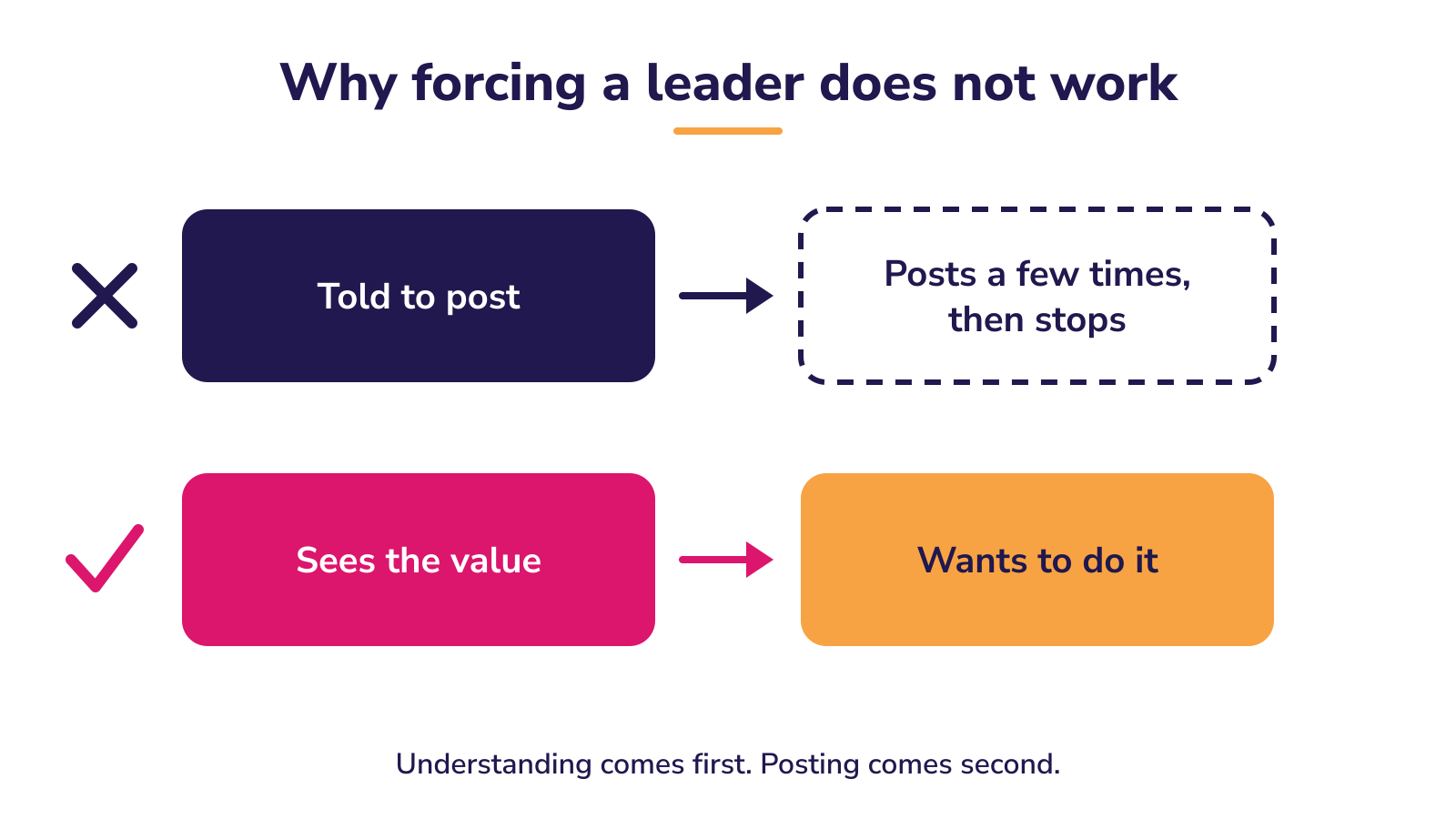
Forced posts also look forced. Readers can feel when a leader is posting out of duty: the text is careful, generic and says nothing. That kind of post doesn't bring reactions, which confirms the leader's belief that LinkedIn is a waste of time. It's a loop that goes the wrong way.
So the question isn't "how do we make the CEO post?" The question is "how do we help the CEO see why it's worth it?"
We see it happen in three steps: understanding, value, routine.
Step one: the leader has to understand why
The first change happens when the leader understands that LinkedIn matters for the brand, not as a tip from marketing but as something they see for themselves.
This is why, with a new client, we start with training. We try to get as many people from the company in the room as possible, and we especially want the leaders there. For leaders we often run a separate, shorter session of about an hour, because they have less time. We wrote about why one training on its own isn't enough in why most LinkedIn trainings don't work.
What changes a leader's mind in a training isn't a list of tips. It's the logic:
- Your clients look you up. Before a meeting, before a tender, before they sign. Your profile and your posts are part of that check.
- Buyers ask AI first, then check the person. We see more buyers asking ChatGPT or Perplexity who to work with. The AI suggests names. Then a person opens LinkedIn to check. If the leader's profile is empty and nothing happens there, trust doesn't form. This matters even more in international sales, where the buyer has never met you.
- Your future employees look you up. People want to know who they will work for. A leader who is visible and human makes hiring easier.
- People trust people. A company page can say what the company does. A leader can say why, and what they have learned on the way.
- Your target group is usually other leaders. If you're a managing director, the people you most want to reach are often other managing directors. They're on LinkedIn, and they read posts from their peers.
- LinkedIn is social. If a person only talks about themselves and never takes an interest in others, online or offline, people won't take an interest in them either. That's good news for leaders who don't want to brag. The point isn't to praise yourself. The point is to take part.
When this clicks, we see a change of mindset. Not every leader becomes enthusiastic in one session. But the conversation changes from "why should I?" to "how would I?". That's the step that makes everything else possible.
Step two: show the value, and the leader starts to want it
Understanding isn't enough on its own. Most people understand that exercise is good for them. That doesn't make them run.
The second change happens when the leader sees value with their own eyes. When we can show leaders what their LinkedIn presence actually brings, they start to want to do it themselves. Nobody has to push any more.
What does value look like? In our experience, it's usually not a big number. For a leader it's often something much more concrete:
- Who reacted, not only how many. A comment from a client, a partner or a respected person in the industry means more to a CEO than a hundred likes from strangers.
- Who viewed the profile. It's often the first sign that a post reached the right person.
- Conversations offline. Someone mentions a post at a meeting or an event. For many leaders this is the moment it becomes real.
- Messages. A former colleague, a potential partner or a candidate gets in touch because of something the leader wrote.
This is why we measure who engages, not only how much. When we worked with leaders at Port of Tallinn, both started almost from zero. Each got one clear topic, their voice came from interviews, and in reporting we looked at which people and sectors engaged, not just at reach.
There's also a fair way to compare. A leader's post shouldn't be compared with a celebrity's post. It should be compared with the leader's own usual post. Scripe Labs used this method in its LinkedIn Trend Report 2026, an analysis of 3.26 million LinkedIn posts from personal profiles: every post was compared with the median of the same author's last 20 posts. We use the same idea when we show clients their results. The study covers posts in English and German, and its figures show associations, not causes. We explain the method in how to measure an executive's LinkedIn.
One honest note: value isn't instant. The first posts are often quiet. That's normal. A new leader on LinkedIn has a small network that isn't used to seeing them. This is where many companies give up, and this is exactly why step three matters.
Step three: accountability turns it into a routine
Wanting to do something and actually doing it every week are two different things. Leaders are busy, and LinkedIn will always lose to the urgent task of the day unless it has its own place in the calendar.
The third change comes from accountability. When someone is responsible for keeping the rhythm, and the leader knows a short check-in is coming, a routine forms.
In practice that means a few simple things:
- A fixed weekly call. We hold a short call, about 30 minutes once a week, to agree the topics for the next two or three weeks. It's in the calendar like any other meeting.
- A clear owner. Someone, inside the company or outside it, owns the process. They prepare questions, send drafts and remind. The leader doesn't have to remember.
- Posts ready in advance. When three or four posts are ready ahead of time, a busy week doesn't break the rhythm.
- Questions that find stories. Leaders go to events, visit clients and attend trade fairs. In the weekly call we ask what happened, and if there is a photo. Often that's the next post. It's natural, and the leader doesn't have to invent anything.
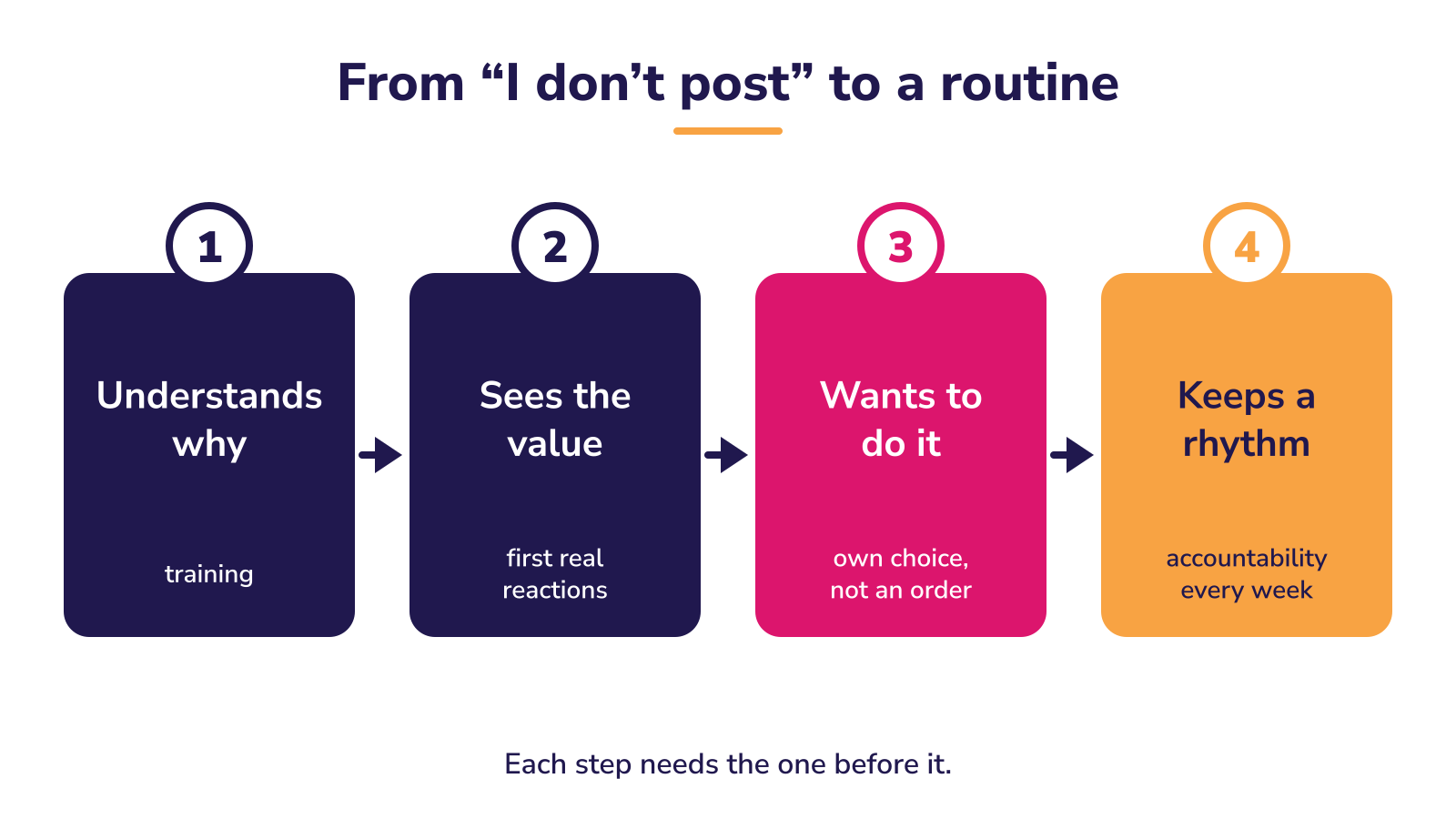
The opposite of a routine is posting when there is time. One month four posts, the next month zero. Then LinkedIn becomes "that other channel" that nobody really owns. A routine protects the leader from that.
Accountability is support rather than pressure. The difference is that the leader has chosen the goal. The routine just helps them reach it.
How to keep a CEO's LinkedIn time low: interviews, not writing
The most common real objection is time. And it's a fair one. If a CEO has to write every post from a blank page, it won't last.
So the leader shouldn't write. The leader should talk.
The best way to get a leader's thinking onto LinkedIn is an interview. When we manage an executive's LinkedIn profile, the process works like this:
- Strategy first. Who is the target group, what do they want to know, and what value can the leader give them? From that come about seven to ten topics. At one post a week, that's roughly two to two and a half months of headlines. We show how to work out the target group in how to map your ideal LinkedIn audience.
- An interview. We take the ideas and interview the leader, for up to 45 minutes when needed. One interview gives material for three or four posts.
- A transcript. The conversation is transcribed.
- Clean-up. AI helps to clean up the raw transcript.
- Writing. A copywriter writes the post in their own words, keeping the leader's thoughts and examples.
- The leader comments. The leader doesn't edit the text. They write comments: which words they would never use, what they like, what they don't like.
That last step is more important than it looks. Through those comments we learn the leader's voice. Every round brings fewer comments, because the writer gets closer to how the leader actually speaks.
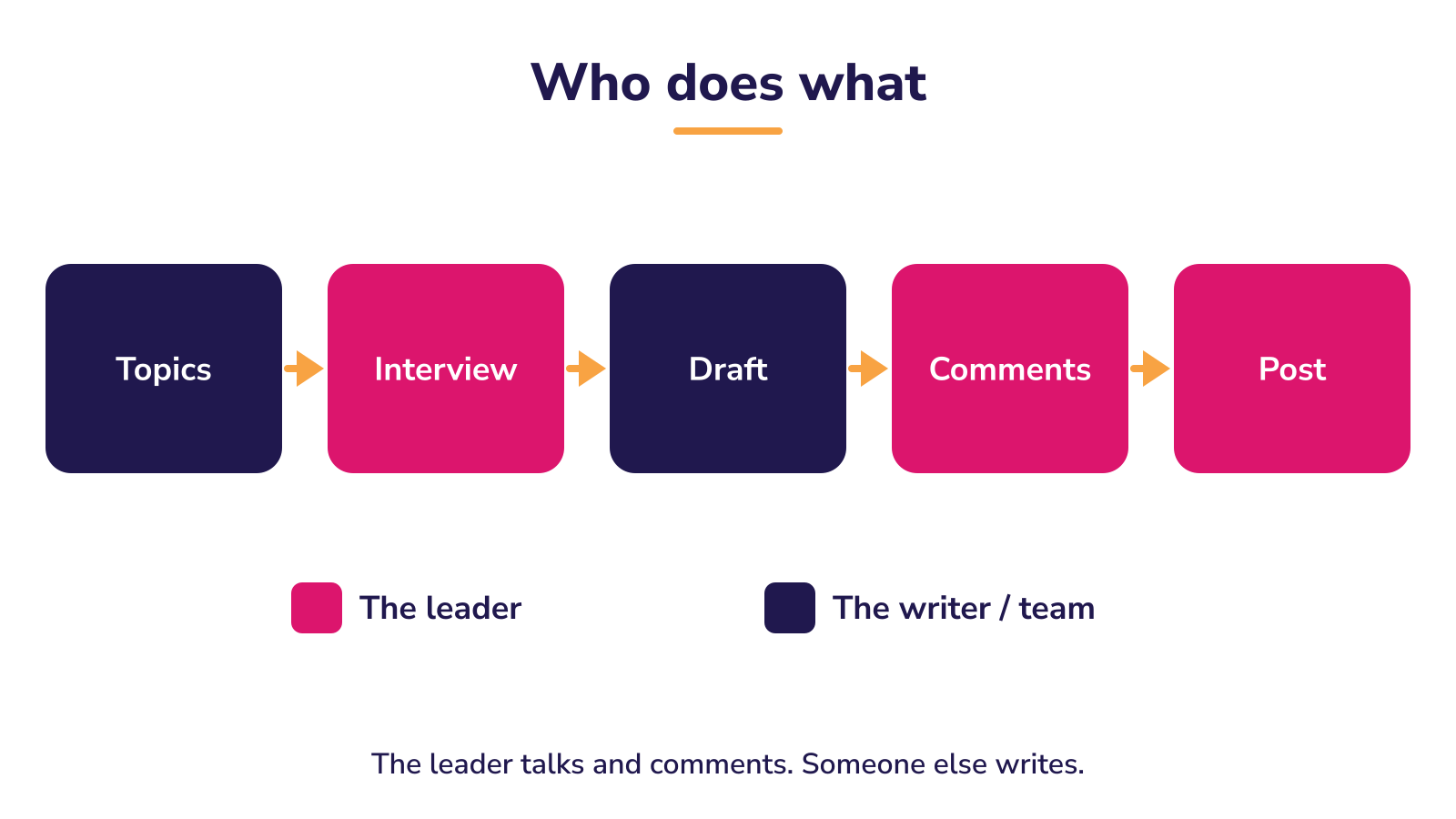
The leader's part is small but real: talk, comment, approve. The thinking is theirs. The writing is someone else's job.
Some leaders worry that this isn't authentic. It's a fair question. The answer is that the ideas, the stories and the opinions are the leader's own. Nobody invents them. A writer turns a spoken thought into a readable post, the same way a speechwriter or a communications team has always worked. What doesn't work is the opposite: empty posts generated entirely by AI, with nothing of the leader in them. People can tell.
Start smaller than you think
Many leaders are put off because the advice they hear is too big. Post every day. Comment for half an hour. Build a personal brand.
For a leader who has never used LinkedIn, that's too much. International advice is usually written for people with a large English-speaking audience. If you tell a managing director who posts in their own language and has barely logged in that they need ten comments a day, they won't write any.
So start small:
- One comment a day. If you're at zero, that's enough. A thoughtful comment of a few sentences on a client's or a peer's post. It takes less courage than a post, and it's how people start to notice you.
- Later, about 20 minutes a day. When one comment has become a habit, that's a good target.
- One post a week. That's enough at the start. A steady rhythm is worth more than a burst of activity.
- Fix the profile. When a comment or a post works, people click on the profile. It should say clearly who you're and what you do. We go through it section by section in how to optimize your LinkedIn profile for B2B sales.
Small steps also make the routine easier to keep. A leader who does a little every week will do more after six months than a leader who started big and stopped in week three.
What a leader should post first
A common fear is: "I don't have anything interesting to say." Usually the leader has plenty. They just don't see their own work as content.
The easiest first posts are about something that actually happened. In Scripe Labs' data, posts about real events beat the author's usual post most of the time: an announcement of a new role did better four times out of five, a personal milestone seven times out of ten, an award six times out of ten. Advice posts about AI, sales or marketing stayed at the author's normal level.
For a leader that means good first topics are:
- something the team achieved, told through the people who did it;
- a decision the leader made, and why;
- what they learned at an event or from a client visit;
- a milestone for the company or for themselves;
- a mistake and what changed after it.
The same report found that, of 22 common LinkedIn tips it tested, only one held up for everyone: show your face. A real photo of the leader, at a real moment, is a simple place to start. We write more about this in what to post on LinkedIn as a CEO and in our summary of LinkedIn trends 2026.
What to avoid at the start: posts that only praise the company, award posts that are really self-praise, and very short posts with nothing in them. These are exactly the posts that confirm a leader's fear that LinkedIn is for showing off.
Mistakes that make a leader quit
Most leaders who stop posting don't stop because of one bad post. They stop because of how the process was set up. These are the mistakes we see most often:
- Starting with a post instead of understanding. The leader is asked to post before they know why. The first quiet post confirms their doubts.
- Making the leader write. A blank page every week is the fastest way to lose a busy person.
- Measuring the wrong thing. Reach alone tells a leader very little. Who reacted tells a lot.
- No owner, no rhythm. If nobody keeps the calendar, LinkedIn gets pushed aside by the first busy week.
- Too much, too soon. Daily posts and long commenting sessions from week one. It doesn't last.
- Posts that don't sound like the leader. If the leader reads a draft and thinks "I would never say that", trust is gone. That's why the comments step matters so much.
Every one of these can be fixed. And none of them is about the leader being the wrong person for LinkedIn.
How to apply this: step by step
- Don't start by asking the CEO to post. Start by helping them understand why their presence matters for the brand.
- Get the leaders into a training, or give them a short separate session.
- Define the target group and seven to ten topics before the first post.
- Set up interviews so the leader talks instead of writes.
- Let the leader comment, not edit. Use the comments to learn their voice.
- Book a short weekly call for the next two or three weeks of topics.
- Keep three or four posts ready in advance.
- Start with one comment a day and one post a week.
- Show the value regularly: who engaged, what conversations started.
- Give it time. The first posts are often quiet. The routine is what carries it.
FAQ
What if our CEO really doesn't want to be on LinkedIn? Don't force it. Forced posting stops after a few posts. Start with understanding: why their presence matters for clients, employees and the brand. Many leaders change their mind once they see the logic and the first real reactions.
How much time does a CEO need for LinkedIn? Less than most think, if they don't write the posts themselves. With an interview-based process, the leader talks, comments on drafts and approves. Add one thoughtful comment a day at the start.
Is it authentic if someone else writes the CEO's posts? Yes, if the ideas, stories and opinions are the leader's own and come from interviews. The writer turns spoken thoughts into readable text. Empty posts generated entirely by AI, with nothing of the leader in them, don't work.
What should a CEO post first? Something that actually happened: a team result, a decision, a milestone, a lesson from a client visit or event. Use a real photo where you can.
How often should a CEO post on LinkedIn? Start with one post a week and keep it steady. A steady rhythm is worth more than a burst of posts followed by silence.
When does a CEO's LinkedIn bring leads? Not in the first two months. A company page is a supporting channel, and we don't promise leads from it. With a leader's personal profile, in our experience the first enquiries usually come in month four or five. That's why the routine matters: it has to last long enough to get there.
How do we know if it's working? Look at who engages, not only how many. Comments from clients, partners and peers, profile views from the right people and conversations offline are the early signs. Compare each post with the leader's own usual results.
Want to know where your company page or your leaders' profiles stand today? We run a free LinkedIn audit for B2B companies across Europe. You choose what we look at: a leader's personal profile or your company page. We'll tell you what works and what holds you back. Book a free audit
Want us to look at your LinkedIn?
The LinkedIn audit is free, for your company page or a leader's profile, and you speak directly to Indrek.
Get a free audit